
Queues and Consumer Groups
A consumer group reads a stream as work rather than as a broadcast. Where every subscriber to a stream sees every record, the members of a group divide the records between them: one consumer holds a record at a time, and the record is not finished until someone says so.
It is the same log underneath (see Projections), read through a cursor the group shares instead of a cursor per subscriber.
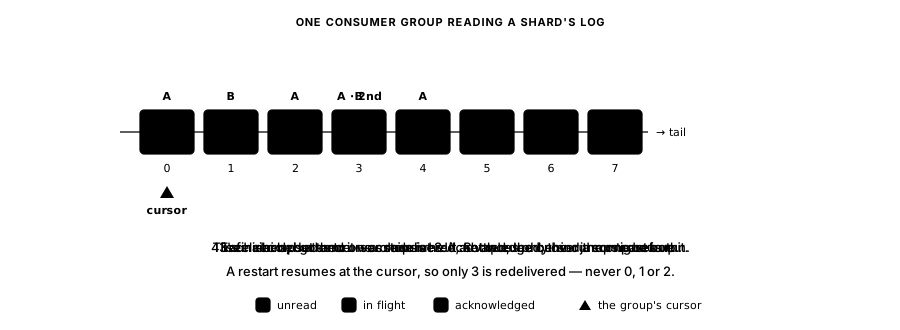
In the middle of the diagram, offset 4 is acknowledged while offset 3 is still held, and the cursor stops at 3 anyway. It only advances over a contiguous run of finished records, which makes the cursor safe to restart from: everything below it is genuinely done, so a broker that restarts redelivers offset 3 and nothing before it.
Moving the cursor to the highest acknowledged offset would be simpler, and would silently drop offset 3 on the next restart.
The loop
Section titled “The loop”loop { // Wait up to five seconds for work rather than spinning. let batch = client .group_poll_wait("t1", "default", "jobs", 0, "workers", 16, Duration::from_secs(5)) .await?;
for record in batch { match handle(&record.payload).await { Ok(()) => { client.group_ack("t1", "default", "jobs", 0, "workers", record.offset).await?; } Err(_) => { // Hand it back now rather than waiting out the timeout. client.group_nack("t1", "default", "jobs", 0, "workers", &record).await?; } } }}An empty batch means nothing was available, not an error.
A poll sees a record once it is written, which is not always when its publish
was acknowledged. A broker run with FELIX_ACK_ON_COMMIT=0 acknowledges
a Leader stream’s publish when it is queued, so a poll sent right after the
ack can come back without it. The next poll gets it. By default a durable
stream acks after the write and has no such gap. Against a broker that opted
out, publish with commit acks: ack_on_commit: true in the producer’s
ClientConfig, or FELIX_ACK_ON_COMMIT=true on the broker.
What the broker guarantees
Section titled “What the broker guarantees”A record is held by one consumer at a time. While a claim stands, no other poll receives that record.
A claim expires. A consumer that stops answering does not hold a record for
ever: after FELIX_GROUP_VISIBILITY_TIMEOUT_MS the record is owed again and
goes to whoever polls next. This is why the loop above must be able to see the
same record twice.
The cursor moves only over a contiguous run of acknowledgements. If you finish offset 6 while 5 is still outstanding, the group’s saved position stays below 5. Acknowledging out of order is fine; the position simply waits.
Owed records go out before new ones, so a redelivery is not starved behind a fast producer.
an_offset_in_flight_is_not_handed_out_again,a_lapsed_claim_is_handed_out_again,the_cursor_does_not_advance_over_a_gap,owed_records_go_out_before_new_ones.
Holes that will not fill
Section titled “Holes that will not fill”Some offsets are settled by the broker and never delivered: generation-start
records a new leader writes, and records retention removed before the group got
to them. A record says how many offsets directly below it went that way
(skipped_before; skippedBefore in Node). A consumer that applies records in
offset order can wait for a missing offset unless this count covers it. The
count is negotiated (FEATURE_GROUP_SKIPPED), and the Felix clients offer it,
so a client that predates it gets the record without the field.
A member that restarts
Section titled “A member that restarts”A claim belongs to the group, not to a process, so a member that dies leaves
its records claimed until the visibility timeout (FELIX_GROUP_VISIBILITY_TIMEOUT_MS,
30 s by default) lapses, and its replacement gets newer records first. A member
that names itself takes them back at once: poll with a stable consumer name
(group_poll_as with a GroupMember in Rust, consumer= in Python, the
consumer argument in Node), and set reclaim after a restart. The names
belong to the principal you authenticate as, so another principal using the same
name gets nothing of yours. A name is 1 to 128 bytes.
The first poll on a new connection that sets reclaim reserves every record the
member still holds from older connections. Those come back to that connection
before anything else, including records owed to the group, over as many polls
as it takes, and nobody else gets them in the meantime. Each counts as another
attempt. One whose claim lapses before you take it back goes to the whole group,
as any lapsed claim does.
Only that first poll reclaims. Leaving reclaim set on every poll is harmless,
and a connection older than the last one to reclaim never takes anything back.
Give each live process its own name: two under one name work, but the newer
takes what the older held when it first reclaims.
Claims are kept in the leader’s memory, so this holds while the shard’s leader stays put; after a failover the group resumes from its durable position anyway.
Retries and giving up
Section titled “Retries and giving up”Every delivery carries attempts, counting this one. 1 is a first attempt;
anything higher is a redelivery, so a consumer can behave differently on a
retry: log it, route it elsewhere, or give up early.
After FELIX_GROUP_MAX_ATTEMPTS deliveries the broker gives up on a record: the
offset is recorded as a dead letter and the group moves past it. Without
that bound, one record that always fails stops the queue at that offset for
ever.
let dead = client.group_dead_letters("t1", "default", "jobs", 0, "workers").await?;for offset in dead { // The record is still in the log at this offset. // Fixed the bug? Put it back: client.group_redrive("t1", "default", "jobs", 0, "workers", offset).await?; // Genuinely unprocessable? Stop tracking it: // client.group_discard("t1", "default", "jobs", 0, "workers", offset).await?;}A dead letter is a pointer to the record, not a copy. The record stays in the stream’s log at that offset, readable by an ordinary replay.
A redrive resets the record’s attempt count and makes it owed again. It does not move the group’s cursor backwards, so everything already finished stays finished. The redrive is durable: it is written to the dead-letter log before the broker answers, so a leader lost before the record is finished leaves the next leader owing it. It stays owed until a consumer acknowledges it, or until it fails its attempts again and goes back on the list.
Redrive and discard change what every consumer of the group sees, so they need
group.manage (or stream.manage) on the stream. Polling, acknowledging,
handing back and listing dead letters need group.consume, which
stream.subscribe also grants. Either can be granted on one group
(group:{tenant}/{namespace}/{stream}/{group}) to keep a principal to the
groups it runs. See Security.
a_record_is_given_up_on_after_the_attempt_bound,a_redriven_record_is_handed_out_again,a_redriven_record_gets_its_attempts_back,a_redriven_record_is_still_owed_after_a_restart.
Limits
Section titled “Limits”- A consumer can only acknowledge or hand back an offset the group has handed
out. Anything else, such as an offset at or past the tail, is refused with
invalid_request: acknowledging a record that does not exist yet would skip it when it is written. - A group on a shard has at most
FELIX_GROUP_MAX_IN_FLIGHTrecords handed out and unsettled at once. A poll past it answers empty, and is counted infelix_group_polls_capped_total, until acknowledgements, hand-backs or lapsed claims free room; a poll waiting at the cap is woken when they do. - One poll hands out at most 1,000 records and stops reading after about 4 MiB
of payload, whatever
max_recordsasks for. The rest stay owed for the next poll. - A group untouched for ten minutes (or twice the visibility timeout, if that is longer) has its in-memory state dropped and rebuilt from disk on its next request. That redelivers anything it still had in flight and restarts attempt counts, the same as a leader change. A group with a claim or a delayed nack still standing is kept until it lapses.
Group state survives a leader failover. The position and the dead-letter list replicate beside the shard’s records, so a promoted leader resumes where the group had got to, lists the records that were set aside, serves a redrive, and still owes any record an operator redrove before the failover.
A replica never holds a group’s position past a record without the dead letter for it: dead letters are shipped first, and a position goes only to a replica that already has every dead letter written before it. So a failover at any point either redelivers a record or lists it as dead, never neither. Before it serves, a promoted leader takes the position and the dead-letter list together from the replica whose copy of the pair is most complete among a majority of the shard’s replicas, never one from one replica and one from another. Group writes are acknowledged once they are durable on the leader, so a failover can still lose the newest ack and redeliver that record.
Reading group state, with group_describe or the dead-letter list, is checked
the same way: a broker answers only while its lease holds or, in a fleet that
reads by round, after a majority confirms it still leads. A deposed leader
refuses instead of answering from state its successor has moved past.
Long work, backoff, and giving up yourself
Section titled “Long work, backoff, and giving up yourself”The visibility timeout and the attempt bound are the broker’s defaults. A
consumer can take each decision for itself, record by record, on a broker that
advertises FEATURE_GROUP_CLAIM_CONTROL.
stateDiagram-v2
    [*] --> Claimed: poll, for its visibility
    Claimed --> Claimed: extend
    Claimed --> Owed: claim lapses, or nack
    Claimed --> Delayed: nack with a delay
    Delayed --> Owed: delay passes
    Owed --> Claimed: next poll, one more attempt
    Claimed --> Finished: ack
    Claimed --> DeadLetter: dead_letter
    Owed --> DeadLetter: out of attempts
    DeadLetter --> Owed: redrive
    DeadLetter --> [*]: discard
    Finished --> [*]
Claim for longer, or shorter, from the start. GroupPollOptions::visibility
sets how long that poll’s claims stand, instead of
FELIX_GROUP_VISIBILITY_TIMEOUT_MS.
Extend a claim you are still working on. A worker calling a slow downstream heartbeats instead of letting the claim lapse:
use std::time::Duration;
let stands = client    .group_extend("t1", "default", "jobs", 0, "workers", &record, Duration::from_secs(60))    .await?;
The claim then stands for the returned duration from now. The extension is for
the delivery you hold: once the claim has lapsed and the record has gone out
again, it is refused with stale_claim, even if this worker is still running.
The record belongs to the group by then, and extending someone else’s claim
would keep it from the group if that consumer died.
Back off before a retry. group_nack_after hands the record back to be
owed again only once the delay has passed:
client .group_nack_after("t1", "default", "jobs", 0, "workers", &record, Duration::from_secs(30)) .await?;Like an extension, the nack is for the delivery you hold, named by
record.attempts. Once the claim has lapsed and the record has gone out again
it is refused with stale_claim, so a late nack cannot take the record from
the consumer now working on it, or push its redelivery back. A plain
group_nack takes the record too and is refused the same way.
While it waits, the record holds a place under FELIX_GROUP_MAX_IN_FLIGHT, so
a group cannot park more than that. Nobody holds it, so it cannot be extended,
and a member that restarts does not reclaim it. Its redelivery counts as an
attempt as usual.
Give up yourself. When the consumer knows a record will never succeed,
group_dead_letter lists it as a dead letter of the group and finishes it,
exactly as the broker does at FELIX_GROUP_MAX_ATTEMPTS: written to the
dead-letter log first, so a crash in between leaves it listed and owed rather
than gone. group_redrive and group_discard work on it as on any other.
A record already finished is refused and not listed.
All three need group.consume, like an ack, and like an ack they are taken for
whatever the group has in play, from any consumer of the group: claims do not
yet say who holds them. Extensions and delays are the leader’s memory, so a
failover hands those records out from the group’s durable position, sooner
than asked. A consumer dead letter is durable and replicates with the shard.
The broker caps visibility, extensions and delays at
FELIX_GROUP_MAX_VISIBILITY_MS. The same calls are on ClusterClient and on
ShardedGroup (extend, nack_after, dead_letter).
The client refuses a delay or a visibility to a broker without the feature bit, rather than sending it: an older broker ignores both fields, and would nack at once or claim for its own timeout without a word.
an_extended_claim_outlasts_the_visibility_timeout,an_extend_after_the_record_was_handed_out_again_is_refused,a_delayed_nack_is_redelivered_after_the_delay,a_consumer_dead_letter_is_listed_finished_and_redrivable,a_tracker_with_a_standing_claim_is_not_evicted,a_consumer_extends_delays_and_dead_letters_its_claims.
Creating, moving and deleting a group
Section titled “Creating, moving and deleting a group”A group comes into being on its first poll, at offset 0. To start it somewhere else, create it first:
use felix_wire::StartPosition;
// Only new work: leave alone a group that already exists, so this is safe on// every start of the consumer.client    .group_create("t1", "default", "jobs", 0, "workers", StartPosition::Latest)    .await?;
Earliest is the oldest record the shard still holds, Latest its committed
tail, and StartPosition::Offset(n) must lie between the two. group_seek
takes the same argument and moves a group that already exists, backwards to
replay or forwards to skip. group_describe says where a group stands, and
group_delete removes its position and dead letters.
let info = client.group_describe("t1", "default", "jobs", 0, "workers").await?;println!("{} records behind, {} in flight", info.lag(), info.in_flight);A seek voids every claim standing when it lands. An ack for a record the group
now owes is refused as stale_claim, and the record is delivered again from
the new position; an ack below the new position is a harmless duplicate.
Dead letters are kept across a seek. The in-flight and owed counts are the
leader’s memory, so they start again from zero when the shard changes leader.
These calls work on one shard. On ClusterClient, group_create_stream,
group_seek_stream, group_describe_stream and group_delete_stream make one
call per shard. Latest is then each shard’s own tail at the moment its call
lands, not one cut across the stream, and an offset is refused for a stream
with more than one shard since offsets are per shard. Creating, moving and
deleting need group.manage; describing needs group.consume. They need a
broker that advertises FEATURE_GROUP_ADMIN.
a_seek_backwards_replays_what_the_group_finished,an_ack_for_a_claim_from_before_a_seek_is_refused,an_ack_racing_a_seek_does_not_move_the_new_cursor,a_group_is_created_moved_described_and_deleted.
What a queue does not promise
Section titled “What a queue does not promise”Order. A shared cursor gives it up the moment two consumers hold adjacent records, and a redelivery reorders regardless of how many consumers there are. A queue preserves the order records are handed out in and says nothing about the order they are finished in. If you need per-key ordering, use a stream with a routing key so related records land on one shard.
Exactly-once. A record can arrive twice: after a claim lapses, after a leader is lost, after an idle group is rebuilt, or after a redrive. Handlers must tolerate seeing the same record again.
A consumer per group member. A group is bound to the shard you name, and nothing assigns shards across a group’s consumers. Running one consumer per shard is the application’s job today; there is no coordinator handing shards out.
Configuration
Section titled “Configuration”| Variable | Default | What it controls |
|---|---|---|
FELIX_GROUP_VISIBILITY_TIMEOUT_MS |
30000 |
How long a claim stands before the record is owed again. Too short redelivers work still being done; too long leaves a dead consumer’s records stuck. |
FELIX_GROUP_MAX_ATTEMPTS |
5 |
Deliveries before a record is dead-lettered. |
FELIX_GROUP_MAX_WAIT_MS |
30000 |
Cap on how long a polling client may ask the broker to wait. |
FELIX_GROUP_MAX_IN_FLIGHT |
10000 |
Most records one group may have handed out and unsettled on a shard. Keeps one consumer that never answers from claiming the whole backlog. |
FELIX_GROUP_MAX_VISIBILITY_MS |
43200000 |
Cap on a poll’s chosen visibility, a claim extension, and a nack delay. Never below FELIX_GROUP_VISIBILITY_TIMEOUT_MS. |
Groups need durable storage: without FELIX_DURABLE_STORAGE_DIR the broker does
not advertise the feature at all, because a position lost on every restart would
redeliver everything each time.