
Delivery Semantics and Consistency Model
What Felix promises about delivery, ordering, durability, and consistency, and what it does not. Applications should rely on what is written here and nothing stronger.
Pub/Sub Delivery Semantics
Section titled “Pub/Sub Delivery Semantics”Delivery Guarantees
Section titled “Delivery Guarantees”A stream’s guarantee follows from how it is registered.
An ephemeral stream is at-most-once. This is the default:
- Messages are delivered to subscribers zero or one time
- No retries or redelivery
- No acknowledgements from subscribers
- Slow subscribers may drop messages without notification. A durable stream’s subscription is told: it ends at the first drop with the offset to resume from
A durable stream is at-least-once. Every record is written to disk before
the publish is acknowledged, and a subscriber replays from any retained offset,
so a record survives a broker restart and can be read again. A stream declared
Quorum waits for a majority of its replicas before acknowledging, so the
record also survives losing the broker that accepted it.
A consumer group is at-least-once, and redelivers. A record handed to a consumer that does not answer is handed to another once the visibility timeout lapses. See Projections.
At-most-once is appropriate for:
- Real-time signals where latest value matters most
- High-frequency metrics and telemetry
- Workloads where occasional loss is acceptable
- Applications that implement their own deduplication
Example at-most-once workload:
// Real-time sensor data where latest reading matters mostlet mut subscription = client.subscribe("acme", "sensors", "temperature").await?;
while let Some(event) = subscription.next_event().await? {    // Process latest temperature reading    // If we miss a reading, the next one will arrive soon    update_dashboard(event.payload);}
At-least-once, and why there is no third guarantee
Section titled “At-least-once, and why there is no third guarantee”At-least-once is implemented in two ways, both described above: replay a durable stream from a checkpointed offset, or consume through a consumer group, which requires an acknowledgement per record, redelivers anything unanswered once its visibility timeout lapses, and dead-letters a record that has been attempted too many times.
Idempotent producers are implemented; exactly-once delivery is not. A
producer takes an id from the broker and numbers its batches, and a batch
re-sent after a lost acknowledgement lands once: the shard’s leader answers a
sequence it already holds rather than appending it again. That closes the
ambiguous-outcome gap on the publish side (ClusterClient::idempotent_producer,
negotiated as FEATURE_IDEMPOTENT_PRODUCER). On a durable stream the
sequences are stored in the log with the records and replicated with them, so a
re-send is answered the same way after a failover, a planned move or a restart;
on an in-memory stream they last as long as the leader. It does not make delivery
exactly-once: a consumer can still see a record twice on redelivery, and
end-to-end exactly-once would also need transactional coordination across the
log and the consumer’s own state, and deduplication on receive. Deduplication
has to live in the application regardless, because only the application knows
what makes two records the same. Deduplicate there, keyed on
something the record carries.
Consistency: how many brokers must hold it
Section titled “Consistency: how many brokers must hold it”A durable stream is replicated to a set of brokers: one leader and its
replicas. consistency on the stream decides how many of them must hold a
record before the publisher is told it is safe.
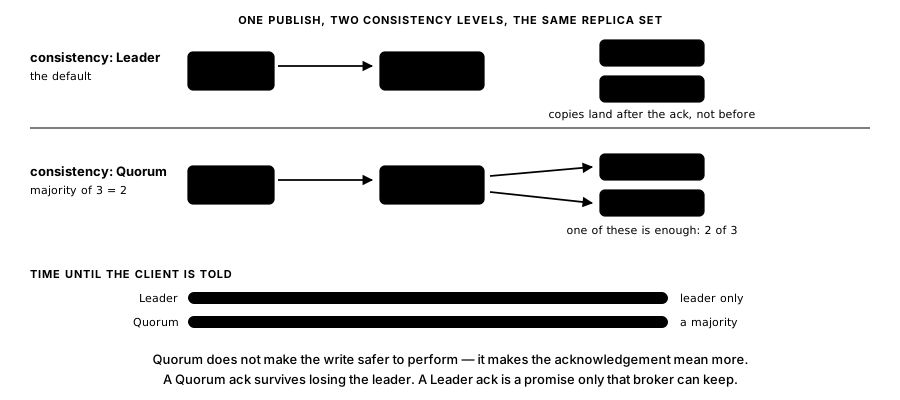
Leader is the default. The leader writes the record to its own log,
durably, and answers. Replication still happens; the acknowledgement simply
does not wait for it. One round trip.
A durable stream’s answer goes out after the write by default. It is committed
when it is in the log and covered by the fsync policy: under the default,
periodic at 250 ms, the bytes are in the log file, so they survive a broker
crash, and a machine crash or power loss can lose the last interval.
FELIX_DURABLE_FSYNC_MODE=on_commit flushes to the device before the ack. An
in-memory stream has nothing to commit and answers when the publish is queued.
A broker started with FELIX_ACK_ON_COMMIT=0 (ack_on_commit: false) answers
on accept instead, when the publish is queued, before the write. It is faster,
and a record acknowledged that way is lost if
the leader crashes before writing it, or if a pause outlasts the leader’s lease:
the write is then refused, because another broker may lead the shard by then.
Near the end of the lease the broker waits for the write anyway, so a lapse
comes back as shard_unavailable, and a loss after an ack is counted in
felix_broker_acked_publishes_dropped_total. For an acknowledgement that
means the record is written, keep the default or use Quorum.
An ack sent on enqueue does not make the record readable yet either. A history
read, a replay or a consumer-group poll sent right after it can miss the record
until it is written. A durable stream’s default ack has no such gap. A client of
a broker that opted out can ask for commit acks on its own connections
(ack_on_commit: true in its ClientConfig).
Under Quorum, the leader writes durably, ships the record to its replicas
concurrently, and answers once a majority of the replica set, counting
itself, holds it. On a set of three that is two, so one unreachable replica
costs nothing. The leader waits for enough of them, not all.
Quorum does not change how the record is stored. The record is written the same way, to the
same log, with the same fsync policy. What changes is what the acknowledgement
means:
A
Quorumacknowledgement survives losing the leader. ALeaderacknowledgement is a promise only that one broker can keep.
How Quorum is enforced
Section titled “How Quorum is enforced”The rule depends on which fleet features an operator has finalized (see Upgrades for the runbooks).
By default, the replication driver reports to the control plane which
replicas hold each record, and the quorum mark that releases an acknowledgement
moves only after that report has landed. The leader also re-checks its lease
before it answers. The ordering closes the one interleaving a model check of
the promotion protocol (task tla:check) finds and no injected fault reaches:
a leader that acknowledges a write and dies before the control plane learns
who holds it. FelixShard.tla explores 5.38M distinct states of this design
without a violation. With the ordering removed it loses an acknowledged record
in a second.
With majority_ack finalized (it needs generation_start too), a Quorum
stream acknowledges a write once a majority of its replicas has answered that
it holds it at the leader’s generation. Neither the report nor the lease is on
the path, and every new leader, promoted or taking over at a move’s
cut-over or hand-back, fences a majority and takes the furthest log before it
serves. A leader cut off from the control plane keeps acknowledging
what its followers hold. Leader streams and caches keep the report and the
lease.
With lease_free_reads finalized as well, a get or counter get on a
replicated Quorum cache confirms leadership with a round instead of the
lease; Cache Semantics describes it. Subscriptions,
replay, Kafka fetches and cache watches on a replicated Quorum shard no
longer stop when the lease lapses: they only ever see the committed mark, which
a replaced leader cannot overstate. They end when the broker learns it was
replaced (a replica refuses it for a newer leader) or when no majority has
confirmed it for a lease duration. A consumer-group poll, ack, nack or
dead-letter change on such a shard is confirmed by the same round before it is
acknowledged, so a replaced coordinator cannot acknowledge one. A cache write the owner’s storage refuses is
answered as an error and never acknowledged, so a read cannot miss a write it
was told succeeded.
What each one costs
Section titled “What each one costs”Quorum costs latency, and it costs availability at the other end: a stream
that cannot reach a majority stops acknowledging writes rather than
acknowledging ones it might not keep. A publish with no reachable majority
waits up to FELIX_PUBLISH_QUORUM_TIMEOUT_MS (5 s by default), then fails
with quorum_timeout, and that error means “this cannot be vouched for”
rather than “this did not happen”: the record may well have landed on the
leader. Retry through an
idempotent producer, which re-sends under the same sequence and cannot land
it twice.
While it waits, retention does not reach those records. On a Quorum stream
retention never deletes past the last acknowledged record, so a long outage
can hold a stream’s log above its size bound until a majority is back.
Losing the leader does not stop a Quorum stream the same way. A follower that
holds every record up to the quorum mark holds everything a client was told is
stored, so it may be promoted even when the leader died holding newer records no
follower had yet. Those were never acknowledged, and an idempotent producer
sends them again to the new leader.
Leader is one round trip instead of two, and it moves the moment you find out.
If the leader dies holding a record nothing else has, the control plane will not
promote a replica, because promoting one would open the shard without that
record and no reader could tell. The shard is left unavailable until the old
leader returns with its disk.
So the trade is mostly about timing, not safety. Both refuse to lose a
record acknowledged after it was written (for Leader, the default on a
durable stream); they differ in when you learn there is a problem:
Quorum at publish time, while you still hold the record, or Leader at
failover time, when the only copy is on a broker that is gone.
task cluster:consistency runs
this: the same fault put to both, on a real three-node cluster.
What a reader sees of a Quorum stream. A consumer group and a Kafka
consumer read only up to the shard’s quorum mark, the committed high-water
mark: a record past it can be lost at failover and its offset reused by the
next leader. A Leader stream’s readers see everything durable on the leader.
Plain subscriptions are gated the same way: live delivery waits for
the mark, the replay ring holds only committed records (after a restart too,
and a follower that drops a dead leader’s uncommitted records drops them from
the ring as well), and history for a resumed subscription is read up to the
mark.
Message Ordering
Section titled “Message Ordering”Within a shard: a key always maps to the same shard, and a shard is one log on one leader, so ordering holds per shard.
graph LR
    P[Publisher] -->|msg 1, 2, 3| B[Broker]
    B -->|msg 1, 2, 3| S[Subscriber]

    style P fill:#e3f2fd,stroke:#334155,color:#111827
    style B fill:#fff9c4,stroke:#334155,color:#111827
    style S fill:#c8e6c9,stroke:#334155,color:#111827
Guarantees:
- Messages from a single publisher to one shard arrive in send order
- A single subscriber sees messages in the order they were enqueued
- Order is preserved through batching and fanout
Across streams: No ordering guarantees.
graph LR
    P[Publisher]
    P -->|msg A| S1[Stream 1]
    P -->|msg B| S2[Stream 2]

    Sub[Subscriber]
    S1 --> Sub
    S2 --> Sub

    Note[msg A and B may arrive in any order]

    style P fill:#e3f2fd,stroke:#334155,color:#111827
    style Sub fill:#c8e6c9,stroke:#334155,color:#111827
Example:
// Publish to two streamsuse felix_client::AckMode;client    .publish("acme", "prod", "user-login", login_event, AckMode::None)    .await?;client    .publish("acme", "prod", "audit-log", audit_event, AckMode::None)    .await?;
// Subscribers to user-login and audit-log may see events in any relative order
Ordering within batches:
// Batch publish preserves order within the batchuse felix_client::AckMode;let messages = vec![msg1, msg2, msg3];client    .publish_batch("acme", "prod", "orders", messages, AckMode::PerBatch)    .await?;
// Subscribers will see msg1, msg2, msg3 in that order
Fanout Fairness
Section titled “Fanout Fairness”Felix enforces subscriber isolation: slow subscribers never block fast subscribers.
graph TB
    P[Publisher] --> B[Broker]
    B --> S1[Fast Subscriber]
    B --> S2[Slow Subscriber]
    B --> S3[Fast Subscriber]

    S1 -->|Processing msgs 1-100| D1[Dashboard]
    S2 -->|Still on msg 23, dropping msgs| D2[Slow System]
    S3 -->|Processing msgs 1-100| D3[Analytics]

    style S1 fill:#c8e6c9,stroke:#334155,color:#111827
    style S2 fill:#ffccbc,stroke:#334155,color:#111827
    style S3 fill:#c8e6c9,stroke:#334155,color:#111827
Isolation mechanism:
Each subscription has its own bounded queue and its own QUIC stream.
Buffer behavior:
- Each subscriber has
subscriber_queue_capacitybuffer slots (default: 512) and holds at mostsubscriber_queue_max_bytesof payload in them (default: 128 MiB), since one slot can hold a whole batch. Frames taken from the queue but not yet written to the subscription’s QUIC stream count against the subscription’s share of its connection’ssubscriber_egress_max_bytes(default: 256 MiB per connection, split equally). A subscription whose share is full stops taking from its queue, so the queue fills and drops for that subscriber only - When either fills, new events are dropped for that subscriber only
- Other subscribers continue receiving events normally
- On a durable stream a drop ends the subscription. The broker delivers what was queued before it, then sends
subscription_laggedwith the first dropped offset, without waiting for another publish; felix-client returns it fromnext_eventas aSubscriptionLaggederror, and does the same for drops in its own queue. A client that did not offerFEATURE_SUBSCRIPTION_LAGGEDkeeps its subscription and can still detect a drop, because delivered records carry log offsets and a jump between consecutive offsets is a drop. The exception is a promoted leader’s generation-start record, which takes an offset and is never delivered; the event after it reports it inskipped_before, so the jump is not mistaken for a drop. - An in-memory stream’s drops are not announced: it has no offsets to resume from.
Configuration:
# Broker configsubscriber_queue_capacity: 512 # Per-subscriber buffer sizesubscriber_queue_max_bytes: 134217728 # Per-subscriber payload bytessubscriber_egress_max_bytes: 268435456 # Per-connection bytes in the writer lanessubscriber_writer_lanes: 4subscriber_lane_shard: autoA larger buffer tolerates more bursty subscribers, trading memory for burst tolerance:
subscriber_queue_capacity: 4096Publisher Backpressure
Section titled “Publisher Backpressure”Publisher behavior: Publishing never blocks on subscriber speed.
sequenceDiagram
    participant P as Publisher
    participant B as Broker Queue
    participant F as Fanout Workers
    participant S1 as Fast Subscriber
    participant S2 as Slow Subscriber

    P->>B: publish_batch
    B-->>P: ack (immediate)
    B->>F: dequeue for fanout
    par Independent fanout
        F->>S1: deliver events
    and
        F->>S2: deliver events (buffer fills, drops)
    end

    Note over P: Publisher never waits for subscribers
Publisher queue:
Publishers write to a bounded queue with configurable depth:
pub_queue_depth: 512 # Queue slots guaranteed per tenantpublish_queue_wait_timeout_ms: 2000 # How long a commit-acked publish waits for roomThe queue is shared between tenants by deficit round robin, and every tenant
is guaranteed pub_queue_depth slots, so one tenant’s burst fills its own
share first. When there is no room for a tenant:
- An enqueue-acked publish is answered at once with
overloaded(detail.reason = "publish_queue_full"), which is retryable: nothing was queued - A commit-acked publish, which is a durable stream’s by default, waits up to
publish_queue_wait_timeout_ms, then is answered the same way. The publish waits off the connection’s read loop, so publishes behind it to shards with room go on; a stream stops reading only once it has 1024 publishes waiting or its byte budget is spent - A stream with more than 1024 answers owed refuses the next acked publish with
the same retryable
overloadedbefore queueing it, so a retry cannot write it twice - A fire-and-forget publish is shed (or waits, with
pub_ingress_wait) - Each is counted in
felix_tenant_publish_queue_full_total{tenant,action}
Tuning publish pipeline:
# Increase parallelismpub_workers_per_conn: 4
# Increase buffer (trades latency for burst tolerance)pub_queue_depth: 2048
# Faster timeout for fail-fast behaviorpublish_queue_wait_timeout_ms: 1000
Disconnection Behavior
Section titled “Disconnection Behavior”Subscriber disconnects:
- Subscription is immediately removed from registry
- Buffered events for that subscriber are discarded
- No redelivery: a plain subscription has no record of what was handled. A consumer group does, and redelivers anything claimed but never acknowledged once its visibility timeout lapses
- Subscriber must re-subscribe. On a durable stream it can resume at a checkpointed offset rather than restarting at the tail; on an ephemeral one the tail is all there is
A subscribe with a start position on a durable stream reports live_offset,
the tail when it joined. Records below it are catch-up and records from it on
are new, with nothing skipped between the two, even under concurrent publishes.
Publisher disconnects:
- In-flight publishes may be lost if not acknowledged
- No automatic retry or persistence of unacked publishes
- Application must handle reconnection and retry logic
Broker restarts:
- In-memory state is lost. Durable streams, the log-backed cache, and consumer-group positions are on disk and survive.
- Active subscriptions are terminated
- Clients detect connection loss and must reconnect
- Durable streams replay after a restart; ephemeral ones cannot
Cache Semantics
Section titled “Cache Semantics”Consistency Model
Section titled “Consistency Model”A cache key hashes to one shard, and each shard has one owner. A broker that
receives an operation for a key it does not own forwards it to the owner, so a
value written through any broker is readable through every other, and two
brokers never hold different values for the same key. A cache declares
Leader (the default) or Quorum when it is created, as a stream does, and
the level decides what an acknowledgement means for puts, deletes and counter
adds alike.
Leader. The owner applies the change and answers. Replicas receive it
afterwards, so the acknowledgement promises only that the owner holds it. The
owner serves reads and writes only while it holds its lease, and refuses them
with shard_unavailable (reason fenced) once the lease lapses.
Quorum. A put, delete or counter add is acknowledged once a majority of
the shard’s replica set holds it, and only while the owner still holds its
lease. A get or counter get takes its value, waits until a majority holds
everything up to the tail it read, and then confirms the owner still leads, so
a value it returns is one a failover cannot take back. A write that does not
reach a majority in time fails with quorum_timeout, and one whose owner
loses the shard first fails with leadership_lost. Both mean the outcome is
unknown, not that the write failed.
By default that confirmation is the lease, which is only as safe as the
brokers’ clocks. Once an operator finalizes lease_free_reads (with
majority_ack and generation_start), a read of a replicated Quorum cache
confirms instead with one round of fences at the owner’s generation, answered
by a majority after the read began. That makes the read linearizable without
relying on clocks. Setting FELIX_QUORUM_READS=lease on a broker keeps its
reads on the lease. Cache writes keep the lease in every mode: majority_ack
applies to Quorum streams only. Cache watches on a replicated Quorum cache
keep going through a lapsed lease once lease_free_reads is finalized, since
they deliver only what the control plane has recorded as committed.
At every level one owner applies each key’s changes in order, so there are no
torn writes. cache_put_if and cache_delete_if write only when the key is
absent or at the version the caller read (see
Conditional writes). Not provided:
- Multi-key transactions
- Causal consistency across keys
TTL and Expiration
Section titled “TTL and Expiration”TTL semantics:
// Store with 60-second TTLuse bytes::Bytes;client    .cache_put(        "acme",        "prod",        "session",        session_id,        Bytes::from(session_data),        Some(60_000),    )    .await?;
// Store without expirationclient    .cache_put("acme", "prod", "config", config_key, Bytes::from(config_value), None)    .await?;
Expiration behavior:
- TTL countdown starts when
cache_putreturnsok - Reads treat an entry as absent the moment its TTL passes, so
cache_getreturnsnull - On a log-backed cache the shard’s leader also writes a delete for each expired entry, once a second and at most 1024 per shard per pass, and every watch of the key receives it
- On an in-memory cache expiry is lazy: an expired entry occupies memory until it is accessed or evicted
Cache Scoping
Section titled “Cache Scoping”Cache entries are scoped to (tenant_id, namespace, cache_name, key):
// These are independent cache entries:client.cache_put("tenant1", "prod", "sessions", "user123", data.clone(), None).await?;client.cache_put("tenant1", "staging", "sessions", "user123", data.clone(), None).await?;client.cache_put("tenant2", "prod", "sessions", "user123", data, None).await?;Isolation guarantees:
- Different tenants cannot access each other’s cache entries
- Different namespaces within a tenant are isolated
- Keys are unique only within their (tenant, namespace, cache) scope
Eviction Policy
Section titled “Eviction Policy”Today: the in-memory cache evicts best-effort under pressure. The log-backed cache does not evict; it compacts, reclaiming superseded and expired records.
- No guaranteed LRU or LFU policy
- Eviction is opportunistic
- Applications should not rely on specific eviction order
Concurrency and Race Conditions
Section titled “Concurrency and Race Conditions”Concurrent writes to same key:
sequenceDiagram
    participant C1 as Client 1
    participant C2 as Client 2
    participant B as Broker

    par Concurrent puts
        C1->>B: put(key=X, value=A)
    and
        C2->>B: put(key=X, value=B)
    end

    Note over B: Last write wins (undefined order)

    C1->>B: get(key=X)
    B-->>C1: value=A or value=B
Behavior: Last write wins, in the order the owner applies the writes,
which the clients do not control. For a value many clients update, use a
counter (counter_add), which the owner adds atomically. To react to changes,
watch the key (watch_cache); see Cache.
Tenant and Namespace Model
Section titled “Tenant and Namespace Model”Existence Enforcement
Section titled “Existence Enforcement”Wire protocol requirement: All data-plane operations must specify tenant and namespace.
{ "type": "publish", "tenant_id": "acme-corp", "namespace": "production", "stream": "orders", "payload": "..."}Broker validation:
The broker enforces tenant/namespace existence:
- Broker syncs metadata from control plane
- Broker maintains local registry of valid tenant/namespace pairs
- Operations for unknown tenant/namespace are rejected with
errorresponse
sequenceDiagram
    participant C as Client
    participant B as Broker
    participant CONTROLPLANE as Control Plane

    CONTROLPLANE->>B: Sync metadata (tenants, namespaces)
    C->>B: publish (tenant=unknown, ...)
    B-->>C: error (unknown tenant)

    C->>B: publish (tenant=acme, namespace=prod, ...)
    B->>B: Validate against registry
    B-->>C: ok
Authorization
Section titled “Authorization”Enforced. Tenant-scoped tokens are verified at the broker, and publish, subscribe and cache operations each check a permission before doing any work.
A forwarded publish is authorized twice, at the broker the client reached and again at the shard’s owner, so routing a request through the cluster does not launder the credential it arrived with.
Enforcement points:
- Publish operations, at ingress and at the owner
- Subscribe operations
- Cache operations
- Control plane operations
Per-tenant quotas are a separate thing, and only the publish rate is enforced; see below.
Quota Enforcement
Section titled “Quota Enforcement”Publish rate only. With FELIX_TENANT_PUBLISH_BYTES_PER_SEC,
FELIX_TENANT_PUBLISH_MSGS_PER_SEC or FELIX_TENANT_PUBLISH_QUOTAS set, each
broker keeps a token bucket per tenant and checks it before a publish is
queued: an acknowledged publish over quota is refused as overloaded with
reason tenant_quota and a retry_after_ms, and a Kafka produce is throttled
with throttle_time_ms. The rate is per broker and set in its environment.
Nothing limits what a tenant can subscribe to, cache or store. The fuller
shape, not built:
quotas: - tenant: acme-corp namespace: production publish_rate_limit: 10000/s subscribe_connections: 100 cache_memory: 10GB stream_retention: 7dConsistency Across Components
Section titled “Consistency Across Components”Broker Internal Consistency
Section titled “Broker Internal Consistency”Within a single broker:
- Publish-fanout ordering: On a durable stream, fanout happens after the commit settles the order, so messages fan out in that order. On an in-memory stream fanout is not ordered against concurrent publishes: two publishers racing can append in one order and fan out in the other, so two subscribers of the same in-memory stream can see that pair differently
- Cache consistency: Single-writer per key (no torn writes)
- Subscription isolation: Independent queues prevent crosstalk
Multi-Broker Consistency
Section titled “Multi-Broker Consistency”In a clustered deployment:
- Shard leadership: Only one leader per shard. A leader acknowledges and
serves reads only while it holds a lease, so a superseded broker stops
rather than discovering the fact later. Two exceptions: a
Quorumstream undermajority_ackacknowledges on its followers’ answers instead, and aQuorumcache read underlease_free_readsconfirms with a round (see HowQuorumis enforced) - Metadata consistency: strongly consistent, because it lives in one Postgres that every control-plane instance reads and writes, or in an embedded Raft group. A Raft member that comes back with a wiped volume withholds its vote until it has caught up, so it cannot help elect a leader missing an acknowledged write (see Raft metadata)
- Cross-shard ordering: Not guaranteed. Ordering is per key, because a key always resolves to the same shard and a shard is one log on one leader
- Cache consistency: One owner per key, with
LeaderorQuorumacknowledgement per cache. See Cache Semantics
Failure Scenarios and Behavior
Section titled “Failure Scenarios and Behavior”Network Partition
Section titled “Network Partition”Publisher-Broker partition:
- Publisher detects connection loss (QUIC idle timeout, 6 s by default)
- Unacknowledged publishes are lost
- Publisher must reconnect and retry
Subscriber-Broker partition:
- Subscriber detects connection loss
- Buffered events are lost
- Subscriber must reconnect and re-subscribe, resuming from its last offset on a durable stream
Broker-Control Plane partition:
- Broker continues serving with cached metadata
- New stream creation fails
- Its lease lapses after the control plane’s expiry window. From then on it
refuses writes to
Leaderstreams and caches, and ends their readers, since another broker may lead those shards by now - A
Leadershard’s single writer rests on that lease. A deposed leader suspended past the lease margins, or one whose monotonic clock runs slow against the control plane’s, can acknowledge a write its successor never sees. A clock step cannot, since neither side reads a wall clock. AQuorumstream withmajority_ack, or cache withfenced_cachesas well, acknowledges only what a majority holds, so it is not exposed - With
majority_ackfinalized, a replicatedQuorumstream keeps taking writes, acknowledged by its followers. Withlease_free_readsas well, its subscribers, cache watches and consumer groups keep going: they end only once a replica refuses the broker for a newer leader, or no majority has confirmed it for a lease duration, and clients then find the new leader as they do after a move - Broker reconciles when connection restored
Broker Failure
Section titled “Broker Failure”Process crash:
- In-memory state is lost. Durable streams, the log-backed cache, and consumer-group positions are on disk and survive.
- Clients detect connection loss
- Clients must reconnect to recovered broker
- Subscriptions must be re-established. A durable stream replays from a checkpointed offset, and a consumer group resumes from its last acknowledged position
- The log-backed cache rebuilds its state from its log
Shard Moves
Section titled “Shard Moves”A drain or a rebalance moves a shard off a live broker. It is not a failure, and clients see less of it than of one:
- Publishes are held, not refused. Between the fence and the cut-over
nobody serves the shard; a publish arriving then waits and is forwarded to
the new owner, which also holds it while it fences its replicas, usually a
round trip. Only a switch-over longer than
FELIX_SHARD_MOVE_HOLD_MS(2 s) refuses one, asshard_unavailablewith reasonmoving, unwritten. - Cache and counter operations are held and forwarded the same way.
Consumer-group operations are held and then redirected to the new owner,
which
ClusterClient‘s group calls (and the Python and TypeScript clients’) follow. - Subscriptions follow. The old leader delivers what it committed, then
ends each subscription with
shard_moved. AClusterClientsubscription resumes on the new owner with nothing repeated or skipped. A cache watch gets the same frame: aClusterClientwatch follows the shard, and aClientwatch must be reopened by the caller. - Nothing acknowledged is lost. Group positions, dead letters, counters and idempotent producers’ sequences move with the shard.
See Adding, draining and removing brokers.
Slow Subscriber Behavior
Section titled “Slow Subscriber Behavior”Scenario: Subscriber processing slows down.
Stages:
- Buffer absorbs slowdown: Events accumulate in subscriber buffer
- Buffer fills: New events start getting dropped for that subscriber
- Other subscribers unaffected: Fast subscribers continue normally
Drops apply to live records only. A subscription resumed from an earlier offset is never dropped from while it replays history: the client waits for room in its queue, so a slow reader slows the replay instead.
Detection, today: the broker counts drops per subscriber queue
(felix_sub_queue_dropped_total) and logs when a subscriber falls behind.
On a durable stream the subscription ends at its first drop with
subscription_lagged, and the subscriber resumes from the offset it names;
ClusterSubscription does that itself, catching up from the log. An
in-memory stream’s subscriber is not told and is not disconnected.
Testing Semantics
Section titled “Testing Semantics”Conformance Testing
Section titled “Conformance Testing”Applications can test semantic guarantees:
Ordering test:
// Publish ordered batchlet messages = vec!["msg1", "msg2", "msg3"];use felix_client::AckMode;client    .publish_batch("test", "default", "orders", messages, AckMode::PerBatch)    .await?;
// Verify subscriber receives in orderlet events = collect_events(&mut subscription, 3).await?;assert_eq!(events, vec!["msg1", "msg2", "msg3"]);
Isolation test:
// Start fast and slow subscriberslet mut fast_sub = client.subscribe("test", "default", "stream").await?;let mut slow_sub = client.subscribe("test", "default", "stream").await?;
// Slow subscriber delays processingsimulate_slow_processing(&mut slow_sub);
// Verify fast subscriber still receives all messageslet fast_count = count_events(&mut fast_sub, timeout).await?;assert!(fast_count >= expected_count);
Summary: Semantic Guarantees Matrix
Section titled “Summary: Semantic Guarantees Matrix”| Property | Today | Not built |
|---|---|---|
| Pub/Sub delivery | At-most-once ephemeral, at-least-once durable; idempotent producers land a re-sent publish once | Exactly-once delivery |
| Consumer groups | At-least-once, bounded redelivery, dead letters | Shard assignment across a group’s consumers |
| Message ordering | Per shard | Configurable cross-shard |
| Subscriber isolation | Yes | None |
| Single-writer fencing | publish_if, and commit with expected_offset: written only at the shard’s next offset, atomic with the claim |
Per-key version preconditions on a commit; writer epochs |
| Cache | Routed to one owner, replicated; Leader or Quorum per cache, covering puts, deletes and counter adds; linearizable Quorum reads with lease_free_reads; conditional put and delete by version |
Multi-key transactions |
| TTL precision | Absent on read the moment it passes, against an absolute expiry; a log-backed cache’s leader writes the delete once a second | Exact-time expiry deletes |
| Durability | Per stream: ephemeral, or Leader or Quorum acknowledgement |
None |
| Authorization | Tenant-scoped tokens, RBAC per resource, OIDC exchange | None |
| Quotas | Per-tenant publish rate, per broker | Per-namespace; subscriptions, cache and storage; set in the control plane |
| Multi-key operations | None | Transactions |
Recommendations
Section titled “Recommendations”Choosing Delivery Semantics
Section titled “Choosing Delivery Semantics”Use an ephemeral stream (at-most-once) when:
- Latest value is more important than history (sensor data, metrics)
- Occasional loss is acceptable (telemetry, monitoring)
- Throughput and latency matter more than guarantees
- Application implements own deduplication
Use a durable stream, or a consumer group (at-least-once) when:
- Every message matters (financial transactions, orders)
- Application can handle duplicates (idempotent processing)
- Durability matters more than latency
Exactly-once delivery is not implemented. An idempotent producer keeps a publish retry from duplicating the record; a consumer’s redelivery is still at-least-once. If duplicates are unacceptable on the consuming side (billing, accounting), the deduplication has to be in the application, keyed on something the record carries.
Cache Usage Patterns
Section titled “Cache Usage Patterns”Good cache use cases:
- Session data with TTL
- Configuration with infrequent updates
- Rate limiting and other counters, with
counter_add - Recently published message lookup
Poor cache use cases:
- Strongly consistent shared state requiring transactions
- Large values (> 1 MB) better served by object storage