
Durable Storage
A stream registered with durable: true writes every publish to a segmented,
checksummed, crash-safe log before the publish is fanned out or acknowledged.
This page covers what that guarantees, how it is built, and what it costs.
The guarantee
Section titled “The guarantee”A record that a durable publish acknowledged is readable after a restart, within the window the configured fsync policy allows.
The window is zero for OnCommit, one interval for Periodic, and
undefined for None.
Durability is opt-in. A broker started without FELIX_DURABLE_STORAGE_DIR is
in-memory only, and a stream the control plane marks durable is rejected at
registration rather than silently downgraded to a guarantee the broker cannot
keep.
Durability is immutable while a stream is registered. Remove and recreate a stream to change it between ephemeral and durable; this explicitly invalidates old handles and prevents durable offsets from diverging from existing in-memory cursors.
Ordering: append, then fanout, then ack
Section titled “Ordering: append, then fanout, then ack”flowchart LR
C(["Client"]) e1@--> P["publish"]
P e2@--> L[("durable log<br/><small>append + assign offsets</small>")]
L e3@--> D{{"fsync<br/><small>OnCommit only</small>"}}
D e4@--> F["fanout"]
F e5@--> S1(["Subscriber"])
F e6@--> S2(["Subscriber"])
D e7@--> A(["ack to client"])
e1@{ animate: true }
e2@{ animate: true }
e3@{ animate: true }
e4@{ animate: true }
e5@{ animate: true }
e6@{ animate: true }
e7@{ animate: true }
classDef store fill:#fdf0e3,stroke:#b07d3a,color:#3d2a12
classDef gate fill:#fbe9d6,stroke:#b07d3a,color:#3d2a12
classDef step fill:#e8f0fe,stroke:#4a6fa5,color:#1a2b40
classDef edge fill:#e9f5ec,stroke:#4a8a5e,color:#16301f
class L store
class D gate
class P,F step
class C,S1,S2,A edge
Nothing downstream of the log observes a record before it is durable: fanout and the acknowledgement both wait for the flush, not the append. The same path, step by step:
sequenceDiagram
    autonumber
    participant C as Client
    participant B as Broker
    participant L as DiskLog
    participant D as Device
    participant S as Subscribers

    C->>B: publish(payload)
    B->>L: append(records)
    L->>L: on the append thread, encode batch, one write() to the page cache

    alt FsyncMode::OnCommit
        L->>D: fsync (shared with concurrent appends)
        D-->>L: durable
    else None / Periodic
        Note over L: returns immediately.<br/>A background timer flushes later
    end

    L-->>B: offsets assigned
    B->>S: fanout
    B-->>C: ack
The append comes first on purpose. A record delivered to subscribers and acknowledged to the publisher but lost in a crash is a silent hole in a log that consumers believe they have read. Writing first turns a storage failure into a failed publish, which the publisher can retry. A storage error can never produce a success acknowledgement.
Where the write runs
Section titled “Where the write runs”The write() into the page cache usually takes microseconds, but once Linux
throttles a process that dirties pages faster than the device takes them, it
blocks for up to hundreds of milliseconds. So no Tokio worker makes it. Each
log has an append thread, and every append runs there in offset order while
the publisher awaits the result. The write runs with the segment lock
released, so readers and flushes never wait on the disk behind it, and a flush
takes its bound on the same thread, behind the appends already queued, so
group commit covers all of them.
Durability policies
Section titled “Durability policies”| Mode | Flush trigger | Acknowledged when | Loss window |
|---|---|---|---|
none |
seal, shutdown | bytes reach the page cache | unbounded |
periodic { interval } |
background timer | bytes reach the page cache | one interval |
on_commit |
the append itself | bytes reach the device | none |
none is not “no durability”: data survives a process crash, because the page
cache belongs to the kernel. It does not survive a machine crash or power loss.
periodic is the default. It is the only policy whose cost is invisible on the
append path while still bounding loss.
A machine crash under periodic or none changes the storage id
Section titled “A machine crash under periodic or none changes the storage id”Under those two policies a follower may have answered its leader for records a
power loss, kernel panic or reboot then lost, while its data directory, and so
its storage id, survived.
Peers would go on counting it on the old position, and placement could promote
it without those records. So a broker records, in <root>/run-state, that a
run is under way before any store opens, and that it stopped cleanly once a
SIGTERM drain has flushed every store with nothing cut short and no log
stopped by a failed fsync. The record also names the machine’s boot id
(/proc/sys/kernel/random/boot_id on Linux).
A start that finds no clean stop after a periodic or none run writes a new
storage id before it registers or answers a peer, unless the record names the
boot still running. Its leaders then copy it again from the start, and
placement no longer counts it on reports from before the crash.
On Linux, a crash of the process alone, such as SIGKILL or an OOM kill, keeps the id.
Every record the broker acknowledged had already been handed to the kernel,
and the page cache that holds it outlives the process, so nothing it answered
for is gone. Before keeping it, the broker calls syncfs on every filesystem
under the data directory, with no timeout, so a later clean stop vouches only
for what is on the device; if that sync fails, the id rotates. macOS cannot
make that sync wait for the device, so there a process crash still rotates
the id and costs a re-copy. A VM or container restored from a memory
snapshot keeps its boot id, so for snapshot-restore workflows run on_commit
or delete storage-id before starting the broker. A failed fsync takes that away: the kernel may have dropped the
pages, so after one the broker forgets the boot, and a crash rotates the id
whatever the boot. A boot id that cannot be read, or a record from an older
release, counts as a machine crash. A clean stop keeps the id, and so does a
crash under on_commit, which acknowledged nothing it had not synced. The first start after upgrading to a
release with this record has none to read, and rotates only if startup would
repair a torn tail, so an orderly roll keeps every id.
A volume restored from a snapshot keeps its id under any policy, on_commit
included, and can hold less than peers counted. So a broker also records, in
<root>/registration, the node incarnation each registration gave it. A
cluster member asks the control plane for its current incarnation before any
store opens, and waits for the answer. When the control plane is ahead, the
node has registered since this directory last saw it, and the start writes a
new storage id. A snapshot taken during the node’s current registration
looks like the live directory and is not caught; see
Backup and restore.
A leader whose machine crashes the same way and restarts before its shard fails
over may have acknowledged records from the tail it lost. It does not reopen
its old generation with the shorter log: it gives up each replicated shard it
led, on disk, so no later start leads that copy either, and does not vote
with it in its successor’s fence. Its reports name its own storage id, so the
control plane sees the new one and promotes a caught-up follower without
waiting for the lease. The broker asks every follower where its copy ends: a
follower that holds at least as much as it kept is promoted, and only when
every follower holds less does the control plane name it leader again at a
new generation. When it cannot hear from every follower and none
is known to be caught up, the shard waits rather than lose what such a
follower holds. A shard with no followers is led from its only copy as before
(#1295). The full
rules are in
docs/durable-storage.md.
A crash keeps the fence promises a broker gave, since those files are synced under every policy. A wiped data directory loses them, so a copy with no promise on disk answers a promoted leader’s fence only once its routing view has the shard, and at that generation only for the leader the view names (#1267).
A follower that crashed under periodic or none, or lost its disk, may
have answered for records it no longer holds. A failover’s assignment names
the storage id each replica had in the report it was decided on, and the
promoted leader counts a fence answer only from that id, so the short copy
never stands in a majority for records it lost. The fence waits for a copy
that can vouch for what it holds, the old leader’s if need be. With the old
leader gone for good the shard stays closed until an operator stops the
promoted broker and runs felixctl placement abandon. That keeps every copy
in the new replica set and takes the furthest, losing only what no copy there
holds (#1335).
On-disk layout
Section titled “On-disk layout”graph TB
subgraph shard["one directory per stream shard"]
direction TB
S0["00…000.log (sealed)<br/><small>offsets 0–999</small>"]
I0["00…000.index"]
S1["00…001.log (sealed)<br/><small>offsets 1000–1999</small>"]
I1["00…001.index"]
S2["00…002.log (<b>active</b>)<br/><small>offsets 2000–…</small>"]
I2["00…002.index"]
end
S0 -.-> I0
S1 -.-> I1
S2 -.-> I2
classDef sealed fill:#eef1f5,stroke:#7a8699,color:#2b3444
classDef active fill:#e9f5ec,stroke:#4a8a5e,color:#16301f
classDef index fill:#e8f0fe,stroke:#4a6fa5,color:#1a2b40
class S0,S1 sealed
class S2 active
class I0,I1,I2 index
Appending, and reading back
Section titled “Appending, and reading back”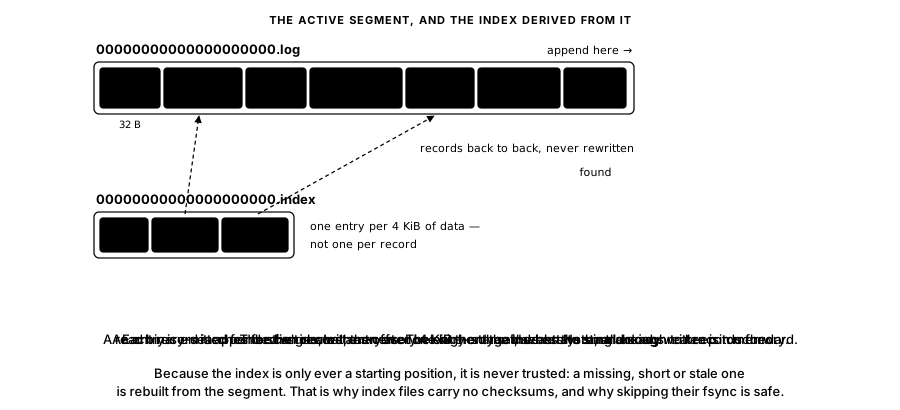
Each record carries its own length, logical offset, timestamp and a CRC-32 over its header and payload. The length comes first and is covered by the checksum, so a reader can step to the next record without decoding the current one’s payload. That keeps index rebuilds and recovery scans cheap.
Index files are pure accelerators. An entry is emitted for a segment’s first
record and thereafter every index_spacing_bytes (4 KiB by default), so the
index is sparse: it says roughly where to start, and the forward scan over
real records is what actually answers the read.
That is also why they carry no checksums and are never trusted. An entry is only ever a starting position for a scan that re-validates what it finds, so a missing, short, or stale index costs a rebuild rather than a wrong answer. It is also why a freshly written index can safely skip its fsync.
A new replication leader also writes a generation-start record into the log
(see the format specification). It takes
an offset like any other record. read_range returns it, but only replication
reads the log that way (StreamLog::read_log_from), because it ships and
compares the log exactly as stored. Subscribers and every other reader go
through StreamLog::read_from, which skips these records, so they see a gap
of one offset where each one sits.
Sealing, rolling, and retention
Section titled “Sealing, rolling, and retention”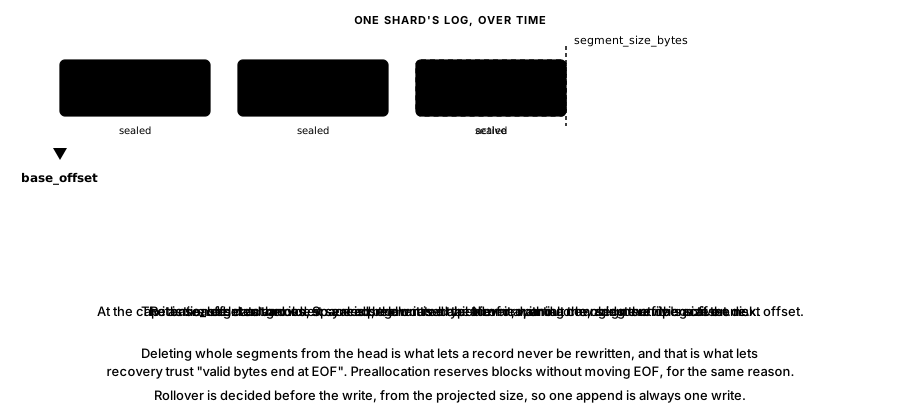
A shard’s log is one active segment plus any number of sealed ones.
Rollover is decided before a write, from the projected size, so one append is
always one write call and a batch never spans two segments. Sealing syncs the
data and the index, then trims the preallocated tail so the file on disk is
exactly its contents.
The active segment reserves blocks ahead of its writes without changing the file’s size. It starts with 1 MiB and doubles the reservation each time its records pass half of it, up to the segment size, so an idle stream holds 1 MiB per shard rather than a whole segment. The extension runs off the append path and is best effort: a failed one is logged and later writes allocate their own blocks.
Retention deletes whole sealed segments from the head only. It never deletes a
partial segment or the active one, so a log always retains at least what
was written since its last roll. base_offset then advances, and a read below
it is Trimmed { requested, oldest } rather than an empty answer, so a
resuming subscriber can tell “those records existed and are gone” from
“nothing here yet”.
On a Quorum shard retention also stops at the commit offset, on the leader and
on every follower: a segment holding a record a majority may not have yet is
kept, however far over its bound the log is. Without that, a follower rebuilt
at the leader’s new base would count as holding records nobody had, and a
waiting publish would be acknowledged for them. Compaction’s head trims stop
at the same place. Leader streams are not held.
The segments go oldest first, with a directory sync after each unlink, so a power loss partway through a sweep leaves a longer log rather than a gap that recovery would refuse.
Cache and counter logs are trimmed the same way, by compaction rather than by
a bound. A background pass seals the active segment, copies each record still
live below it to the tail (a put of the same value, or a counter checkpoint),
flushes, and deletes the sealed segments below the seal point, oldest first.
No record is rewritten, a crash anywhere in the pass replays to the same state,
and no write waits for it: the pass is paced by its own I/O budget,
FELIX_STORAGE_COMPACTION_BYTES_PER_SEC. A cache’s pass then writes its key
index to keys.idx, so the next open replays only the log past it; one that
does not match the log is ignored (see
the storage format).
A shard with <shard>.compacting or <shard>.retired siblings, left by a
directory-swap compaction that stopped partway, is settled on open: a missing
shard directory is restored from <shard>.retired, and leftover siblings are
deleted.
Deleting a stream, and creating it again
Section titled “Deleting a stream, and creating it again”A new cluster finalizes stream_incarnations and cache_incarnations at its
first broker registration; an upgraded one waits for the operator. Once the
fleet has finalized stream_incarnations, a stream deleted and
created again under the same name starts empty: offset 0, no records, no
producer state, no group positions, no dead letters.
sequenceDiagram
    participant CP as Control plane
    participant B as Broker
    participant D as Data directory
    CP->>B: orders deleted through incarnation 7
    B->>D: write marker (retiring, deleted through 7)
    B->>B: unregister, end readers, close logs
    B->>D: rename incarnation 7's dirs into .deleted/
    D-->>D: removed in the background
    CP->>B: orders created, incarnation 9
    B->>D: open orders_0-…-0000000000000009 (empty)
After the finalize each creation of a name gets a higher incarnation than the
last, and its shard, group and dead-letter directories carry it in their
names. Streams created before keep incarnation 0 and their directory names. A
marker per stream under .streams/ records the incarnation registered here
and how far the control plane said the name is deleted.
A broker never moves a name to a lower incarnation, or to one the control
plane deleted. Such a registration can only come from an older catalog view,
such as a control-plane member that is behind, so it is refused and counted in
felix_broker_stream_incarnation_refused_total. A record without an
incarnation for a name the broker has seen incarnated is refused the same way.
Data goes only on the control plane’s word: a Deleted change carrying
deleted_through, a tombstone in the catalog snapshot, or an operator’s
removal. Every incarnation of the name up to the one named is deleted. The
marker is written first, so a delete cut short by a crash is finished at the
next start, and the rename into .deleted/ is atomic, so a directory is
either in place or out of service, never half deleted. A broker that was down
through a delete and a recreate learns of the delete from the snapshot’s
tombstones. A higher incarnation registered on its own only stops the old one
serving and keeps its data.
A delete from before the finalize carries no deleted_through, and the broker
keeps that stream’s data, as it always did: a stream created again at
incarnation 0 reopens it, because its shards restart at the generations the
old one used and an empty log there would be judged by what was kept for the
old one. That data goes when a tombstone covers incarnation 0.
An incarnated stream’s shards start above every generation the deleted one
reached, so the quorum marks and follower positions brokers kept for it never
count for the new records. A shard assigned before its stream is registered
waits without holding up other shards, and a follower refuses records for an
incarnation it does not hold. See docs/durable-storage.md (“Deleting a
stream”) for the whole mechanism and what it does not cover yet.
Deleting a cache, and creating it again
Section titled “Deleting a cache, and creating it again”Caches follow the same design once the fleet has finalized
cache_incarnations, a feature of its own. A cache deleted and created again
starts with no entries and no counters. Each creation of a cache name gets a
higher incarnation, and its shard directories under caches/ and
counters/ carry it. Caches from before keep incarnation 0 and their
directories, so an upgrade moves nothing. A marker per cache under the cache
store’s .streams/ records what the broker holds. Stale registrations are
refused and counted in felix_broker_cache_incarnation_refused_total, and
data goes only on a Deleted change with deleted_through, a snapshot
tombstone or an operator’s removal, from both stores at once. Replication of a
cache shard and its counter log names the incarnation, and a follower holding
another refuses it. A broker without durable storage drops a deleted cache’s
entries from memory. See docs/durable-storage.md (“Deleting a cache”).
The full byte layout, versioning rules, and corruption verdicts are in the Durable Segment Format specification.
Resuming a subscription
Section titled “Resuming a subscription”Records that survive a restart are only useful if a reconnecting client can say
where it got to. A subscriber asks for a start position (latest, earliest,
or an exact offset), and every delivered event
carries its offset, so the client has something to checkpoint.
The hard part is joining history to live delivery without losing a record in between, and the ordering that does it is not the obvious one.
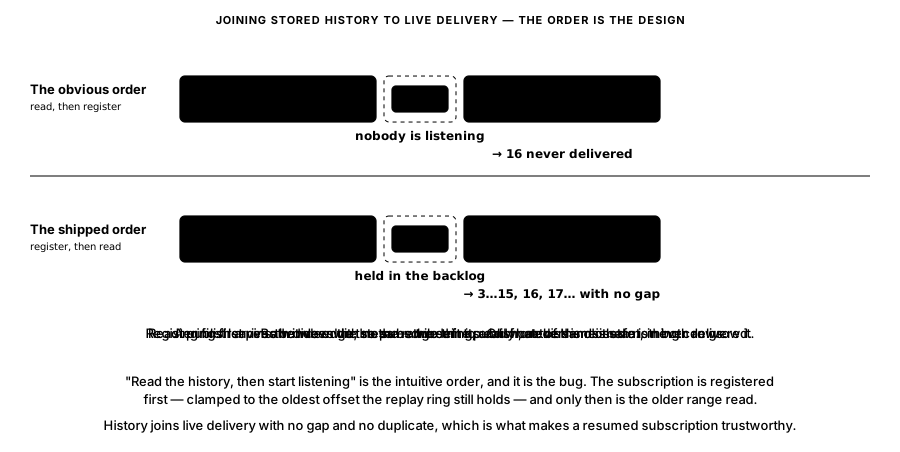
Registering first pins the live edge. Everything below it is a closed range that nothing can grow, so the disk read that follows cannot race a publish. Do it the other way around and the window between the two steps has nobody listening in it.
Recovery
Section titled “Recovery”flowchart TD
START(["open shard directory"]) --> DISC["list segments,<br/>sort numerically"]
DISC --> SEALED["sealed segments:<br/>validate header, load index,<br/>check records past the last entry"]
SEALED --> GAP{"offsets contiguous?"}
GAP -->|no| FAIL(["startup error<br/><small>names shard, segment, byte position</small>"])
GAP -->|yes| ACTIVE["full scan of the newest segment"]
ACTIVE --> DMG{"damage?"}
DMG -->|none| READY
DMG -->|"torn tail"| TRUNC["truncate to the<br/>last intact record"] --> READY(["ready"])
DMG -->|"interior corruption"| FAIL
classDef ok fill:#e9f5ec,stroke:#4a8a5e,color:#16301f
classDef bad fill:#fdeaea,stroke:#b04a4a,color:#3d1414
classDef step fill:#e8f0fe,stroke:#4a6fa5,color:#1a2b40
class START,READY ok
class FAIL bad
class DISC,SEALED,ACTIVE,TRUNC step
Four properties hold:
- A torn tail is repaired. A crash mid-append leaves a partial record at the end of the newest segment. It was never acknowledged under any policy, so it is truncated away. A log whose only segment never got its header, because the disk filled while the log was being created, starts again empty.
- Committed data is never silently discarded. Corruption anywhere else is a startup error naming the shard, segment and byte position. Refusing to start beats losing acknowledged records quietly.
- Recovery is idempotent. Reopening an already recovered log changes nothing, so a crash during recovery is safe.
- Indexes are derived. A missing or stale index is rebuilt, and the rebuilt index is byte-identical to one written during append.
Startup cost is bounded: the active segment is always scanned in full, sealed
segments only past their last index entry. Every read verifies the checksum of
every record it returns, so bit rot in cold data is still caught, though when it
is read rather than at boot. Set FELIX_DURABLE_VERIFY_ALL_ON_OPEN=true to trade
startup time for eager detection.
Recovery plans every repair before it makes any, and
felix-broker inspect segments runs that plan alone: it reports what startup would
do with a data directory, read-only, without a broker. See
Diagnosing a cluster.
Anything that deletes segments does it one synced unlink at a time, in an
order that keeps the chain whole. Retention and compaction go oldest first.
Replication’s truncation and reset go newest first, and a reset creates its
new segment only once the old ones are gone. A power loss partway through
leaves a longer log, never a gap. Recovery refuses to open a log with a gap at
the head; the manual fix is in docs/durable-storage.md, under “A gap at the
head left by an older build”.
Idempotent producers’ sequences are part of what an open rebuilds. Each record a producer writes carries its producer id and sequence, and a broker derives every producer’s place from its own log before the shard takes a write: from the snapshot saved at the last rollover, plus the active segment the scan above already read. That is also why a promoted replica or a move’s destination answers a producer’s re-send: it derives the same state from the records it was shipped.
What durability costs
Section titled “What durability costs”Measured on an Apple Mac Studio (M4 Max, 16 CPUs), APFS on internal NVMe,
128-byte payloads. Latencies are per append call.
| Policy | Batch | Concurrency | Records/s | p50 | p999 |
|---|---|---|---|---|---|
none |
1 | 1 | 571,898 | 1µs | 5µs |
periodic |
1 | 1 | 492,106 | 1µs | 7µs |
periodic |
16 | 1 | 2,671,267 | 3µs | 8µs |
on_commit |
1 | 1 | 253 | 3.99ms | 10.7ms |
on_commit |
1 | 64 | 14,387 | 4.07ms | 9.2ms |
on_commit |
16 | 64 | 185,905 | 4.96ms | 9.2ms |
on_commit latency is a hardware constant. p50 is ~4ms in every row, which is
one APFS device flush. No software makes a single durable commit faster than the
device.
Throughput still scales with concurrency because of group commit. An
fsync flushes the whole file, so one flush can satisfy every append waiting on
it. 253 → 14,387 records/second from concurrency 1 → 64 is a 57× gain from the
same code path, and batching on top reaches 185,905.
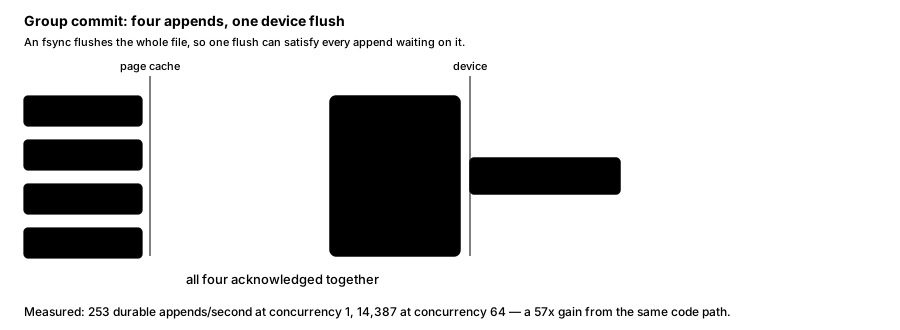
The lock protocol behind that picture (who flushes, and what the others find when they wake):
sequenceDiagram
    participant A as append A
    participant B as append B
    participant C as append C
    participant L as flush lock
    participant D as Device
    participant M as durable bound

    A->>L: acquire
    B->>L: (queued, watching the bound)
    C->>L: (queued, watching the bound)
    A->>D: fsync
    D-->>A: durable through offset N
    A->>M: publish N
    A->>L: release
    M-->>B: covered
    M-->>C: covered
    Note over B,C: return together<br/>without flushing
The others wait on the lock and on the durable bound at once, so one flush wakes them all together rather than one after another through the lock.
The full matrix, the regression budget, and the reasoning behind each optimisation are in the performance document.
Configuration
Section titled “Configuration”| Variable | Default | Meaning |
|---|---|---|
FELIX_DURABLE_STORAGE_DIR |
unset | Root directory; setting it enables durable streams |
FELIX_DURABLE_FSYNC_MODE |
periodic |
none | periodic | on_commit |
FELIX_DURABLE_FSYNC_INTERVAL_MS |
250 |
Interval for periodic |
FELIX_DURABLE_SEGMENT_BYTES |
268435456 |
Rollover size |
FELIX_DURABLE_INDEX_SPACING_BYTES |
4096 |
Sparse index interval |
FELIX_DURABLE_MAX_RECORDS_PER_READ |
10000 |
Record cap on one range read |
FELIX_DURABLE_PREALLOCATE |
true |
Reserve segment blocks ahead of the writes: 1 MiB at creation, doubling as the segment fills |
FELIX_DURABLE_VERIFY_ALL_ON_OPEN |
false |
Checksum every segment at startup |
FELIX_DURABLE_REPAIR_CHECKSUM_TAIL |
false |
Truncate a complete trailing record that fails its checksum (see below) |
FELIX_STORAGE_COMPACTION_BYTES_PER_SEC |
67108864 |
I/O budget for cache and counter compaction; 0 is unlimited |
Invalid combinations fail at startup, not at the first publish.
FELIX_DURABLE_STORAGE_DIR=/var/lib/felix/streams \FELIX_DURABLE_FSYNC_MODE=on_commit \ cargo run --release -p felix-broker-service --bin felix-brokerObservability
Section titled “Observability”| Metric | Answers |
|---|---|
felix_storage_append_duration_seconds |
how long a durable publish takes end to end |
felix_storage_sync_duration_seconds |
how much of that is the device |
felix_storage_sync_batch_appends |
group-commit fan-in in records per flush; near 1 under single-record load means no batching |
felix_storage_unsynced_bytes |
data a crash would lose right now |
felix_storage_sync_failures_total |
non-zero means acknowledged durability is in doubt |
felix_storage_full_total |
writes and log creations refused because the disk or quota was full; none of them wrote anything |
felix_storage_recovery_truncated_bytes |
bytes discarded from a torn tail |
felix_storage_producer_state_rebuilt_total |
opens or truncations that read sealed segments to rebuild idempotent producers’ state, because the snapshot was missing or out of date |
The first two together tell you whether durability is the bottleneck. If sync dominates append, the fsync policy is the cost.
See it work
Section titled “See it work”cargo run --release -p felix-broker-service --bin durable-restart-demoPublishes to one durable and one non-durable stream, drops the broker with no graceful shutdown, boots a second broker over the same directory, and reads both back. It checks its own results, so a regression makes it fail instead of printing wrong numbers.
Limits today
Section titled “Limits today”- Retention is off by default. A stream’s own
retentionbounds its shard logs, and a bound it leaves unset comes fromFELIX_DURABLE_RETENTION_BYTESorFELIX_DURABLE_RETENTION_SECONDS. A patch takes effect without a restart. - Offload, but no cold reads. With
FELIX_DURABLE_OFFLOAD_DIRset, a stream log’s sealed segments are copied to that directory, checked by size and CRC-32, and recorded in a per-shardoffload.manifestbefore retention may delete them. Keys start with the broker’s node id (FELIX_NODE_ID, or an id kept innode-idunder the data directory), so brokers can share one offload directory. A crash at any step leaves the local segment or a recorded copy. Nothing reads the copies yet, so a read below the local head is stillTrimmed, and the only backend is a local directory. A missing or read-only offload directory does not stop a log from opening or taking publishes, but retention keeps every segment without a copy until the directory is back, so an outage grows local disk; watchfelix_storage_offload_held_bytesand see Diagnosing a cluster. Seedocs/durable-storage.md, “Tiered storage: offload”. - Single node. This page describes one broker’s storage; replication
across brokers is layered on top of it, and
seal’s checksum andread_range’s bounded paging exist to serve that.