
Felix Durable Segment Format (v4)
This document defines the on-disk representation of a durable Felix stream. It is
the source of truth for anyone reading, writing, repairing, or replicating
segment files, and it is intentionally independent of felix-wire: network
framing is allowed to change shape for latency reasons, while bytes already on
disk must stay readable by every later build.
Implementation:
crates/server/felix-storage/src/segment/format.rs.
The two must move together; a change to one without the other is a bug.
This page is the byte layout. For how those bytes are produced and consumed over time (appending, the sparse index, sealing, rollover and retention), see Durable Storage, which walks both through animated diagrams.
- Versioned. A reader that does not understand a file says so instead of guessing.
- Self-validating. Every record carries a checksum over its own header and payload, so bit rot and torn writes are detected on read instead of inferred.
- Skippable. The next record’s position is derivable without decoding the current one’s payload, which is what makes index rebuilds and recovery scans cheap.
- Bounded. No length read from disk is used to size an allocation before it has been range-checked.
Conventions
Section titled “Conventions”- All integers are big-endian, matching
felix-wire. - Offsets are logical: a
u64that is stable for the life of a record and independent of where it lands in a file. - A segment is one file of records. A shard is a directory of segments plus their indexes.
Magic numbers
Section titled “Magic numbers”Both file kinds start with a four-byte ASCII magic sharing the prefix FLS
(FeLix Segment), with the last byte naming the kind:
| Magic | ASCII | Expands to | File |
|---|---|---|---|
0x464C5347 |
FLSG |
Felix Segment | segment data (*.log) |
0x464C5349 |
FLSI |
Felix Segment Index | sparse offset index (*.index) |
They are deliberately distinct from felix-wire’s frame magic 0x464C5831
(FLX1): storage bytes and network bytes are separate formats with separate
versioning, and a file that turned up on a socket (or a frame that turned up in
a segment) should be rejected on its first four bytes rather than misparsed.
Directory layout
Section titled “Directory layout”<root>/ storage-id ← this data directory's identity run-state ← whether the last run stopped cleanly registration ← the node incarnation of the last registration node-id ← the id offloaded keys start with, when offload is on without FELIX_NODE_ID acme_default_orders_0-0d3aed4b998d2798/ ← one directory per stream shard 00000000000000000000.log ← segment data 00000000000000000000.index ← sparse offset index 00000000000000000001.log 00000000000000000001.index epochs ← where each generation began replica ← accepted generation and commit offset, once replicated ballot ← the leader that generation was accepted from producers ← producer snapshot, when any producer wrote here offload.manifest ← segments copied to the object store, once offload has run keys.idx ← a cache shard's key index, once compaction has run acme_default_orders_0-0d3aed4b998d2798-0006411a0ccf2e40/ ← the same shard of a stream with incarnation 0x6411a0ccf2e40 .deleted/ ← directories of deleted streams, waiting to be removed .streams/ acme_default_orders-5c1b0e2fd3a4b7c8 ← which incarnation of a stream this broker holdsThe directory name is a readable rendering of the ShardKey plus an FNV-1a hash
of the exact key. The readable part is lossy (anything outside [A-Za-z0-9-]
becomes _, and components are truncated), so the hash is what guarantees
uniqueness. Dots are excluded on purpose: with no dots in the name, a
component like .. cannot be represented at all.
A stream created after the fleet finalized stream_incarnations has an
incarnation, higher for every creation of its name, and its directories end
in - and the incarnation as 16 hex digits, under groups/ and
dead-letters/ too. A stream deleted and created again therefore never opens
the old one’s directories. Incarnation 0, every stream from before, keeps the
name above. A deleted stream’s directories are renamed into .deleted/ and
removed from there by one background thread per store; being dotted, it is
never read as a shard. .streams/ holds a small text marker per stream
naming the incarnation this broker holds, whether a delete of it is
unfinished, and through which incarnation the control plane said the name is
deleted; the format is in docs/storage-format.md. See Deleting a stream.
Caches work the same way once the fleet finalized cache_incarnations: an
incarnated cache’s shard directories under caches/ and counters/ end in
its incarnation, a cache from before keeps incarnation 0 and its names, and
the cache store’s root has its own .streams/ markers and .deleted/.
File names are zero-padded to 20 digits so lexicographic and numeric order agree. Recovery still parses the number and sorts on it rather than trusting directory iteration order, which is filesystem-defined.
A file name is a segment id, not an offset. The two coincide for the common
log (segment 0 begins at offset 0), but they are independent, and a shard’s
first segment may begin anywhere. That is what lets a replica be given a shard
whose early history is already gone everywhere: its log begins at the oldest
surviving offset, and the offset is read back from the segment’s own header
rather than inferred from its name. A read below that offset is Trimmed,
exactly as it is on a leader whose retention removed the same records.
Segment file
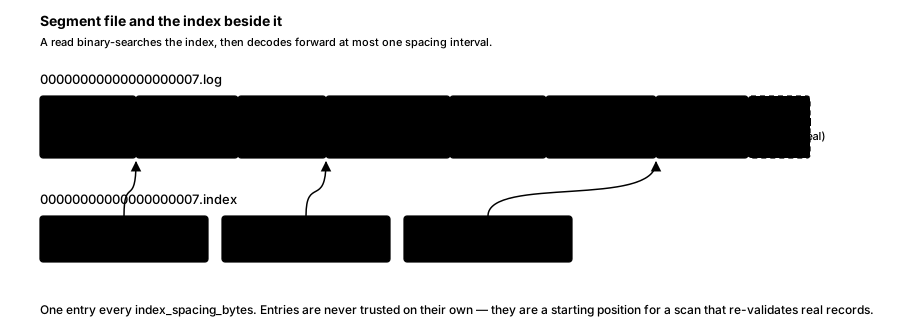
Section titled “Segment file”A 32-byte header, then records back to back, with a sparse index in a companion file:
Segment header (32 bytes)
Section titled “Segment header (32 bytes)”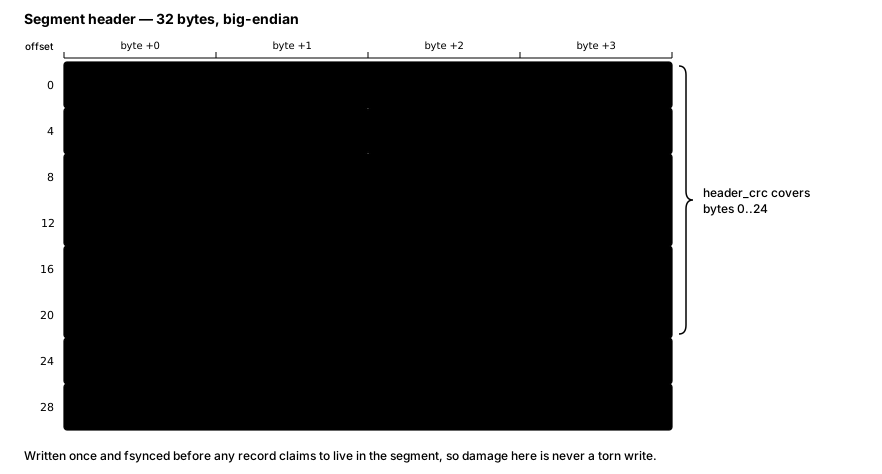
| Offset | Size | Field | Value |
|---|---|---|---|
| 0 | 4 | magic |
0x464C5347 ("FLSG") |
| 4 | 2 | version |
3 when written, or 4 for a segment that holds a generation-start record; 2 is still read |
| 6 | 2 | flags |
0; any other value is rejected |
| 8 | 8 | base_offset |
logical offset of this segment’s first record |
| 16 | 8 | created_at_micros |
wall clock at creation, informational |
| 24 | 4 | header_crc |
CRC-32 (IEEE) over bytes 0..24 |
| 28 | 4 | reserved |
0 |
The header is written once and fsynced before any record claims to live in the segment, so damage here is never a torn write. It is always an error.
Record
Section titled “Record”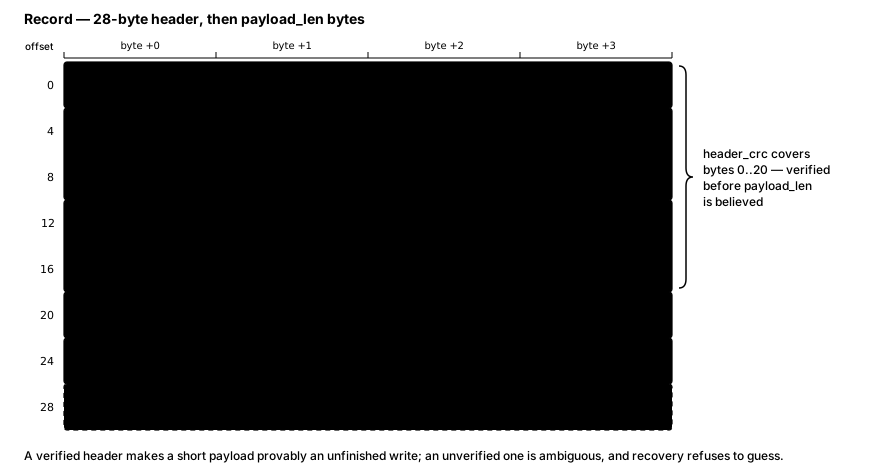
| Offset | Size | Field | Notes |
|---|---|---|---|
| 0 | 4 | payload_len |
low 29 bits: ≤ MAX_PAYLOAD_BYTES (64 MiB); top three bits: the record’s kind, below |
| 4 | 8 | offset |
logical offset; ascends by exactly 1 within a segment |
| 12 | 8 | timestamp_micros |
publish time |
| 20 | 4 | header_crc |
CRC-32 over bytes 0..20 |
| 24 | 4 | checksum |
CRC-32 over bytes 0..24, followed by the tag and the payload |
| 28 | 20 | tag |
only when bit 31 is set: producer_id u64, sequence u64, len u32 |
| 28 or 48 | n | payload |
opaque bytes |
The diagram shows a record without a tag, which is every record not written by an idempotent producer.
header_crc is what makes recovery decidable. It is verified before any other
field is used, so payload_len is only ever acted on once it is known to be
intact. Without it, a bit flip in the length field looks exactly like an
unfinished write (a record claiming more bytes than the file holds), and
recovery would have to guess. Guessing wrong means silently truncating a
record that had been fsynced and acknowledged.
payload_len comes first and is covered by both checksums, so a reader can step
to the next record with position + 28 + payload_len without touching payload
bytes. That keeps the cost of the index rebuild and the recovery scan
proportional to record count rather than to bytes decoded.
The checksum covers the header prefix as well as the payload, so a corrupted offset or timestamp is caught by the same check as a corrupted payload.
Producer marks
Section titled “Producer marks”An idempotent producer’s batch is stored with its producer and sequence, so every copy of the log says whose it is:
- Bit 31 of
payload_len: the record opens a batch. The 20-byte tag names the producer, the batch’s sequence, and how many records the batch has. - Bit 30: the record continues the batch the record before it belongs to.
- Both set is
RecordFlags, and neither is an ordinary record.
Marking every record rather than only the first lets a log tell a batch it
holds all of from one whose leader stopped partway: a batch is held
once its last record is, and one whose next record does not continue it was
abandoned. The step to the next record is 28 + (20 if bit 31) + payload_len,
still from the header alone.
Only a v3 or later segment may hold marks. A v2 build reading a mark’s bits would see a length past the limit, and recovery could take that for a torn tail and cut it off; a v3 header makes the v2 build refuse the segment instead. So a v3 build that reopens a v2 active segment rolls it before writing the first marked record, and leaves unmarked records in it as before.
Generation-start records
Section titled “Generation-start records”Bit 29 of payload_len marks a leader’s generation-start record: the first
record a leader writes at a new generation, before it serves. Its payload
is the generation, a big-endian u64, and it has no tag. It belongs to the
replication protocol rather than a client: it lets the leader’s quorum mark cover the records
it inherited (docs/replication-design.md, “The generation-start record”).
It takes an offset like any record, and every reader but replication skips it: subscriptions and replay, Kafka fetch, consumer groups, and the cache and counter projections. Replication ships and compares it exactly as stored.
At most one of bits 29, 30 and 31 is set; any two is RecordFlags. Only a v4
segment may hold the record, for the reason only a v3 one may hold marks: a v3
build reading bit 29 would see a length past the limit and could cut the record
off as a torn tail, where a v4 header makes it refuse the segment. A v4 build
that reopens an older active segment rolls it before writing the record.
A segment is written at v4 only to hold that record, and the record is written
only once the fleet has finalized generation_start (see the upgrades page in
the docs site). Until then this build creates v3 segments and a v3 build can
still open everything it wrote; after it, the first record rolls the log onto a
v4 segment, and later segments stay at v4. Indexes stay at v3.
Index file
Section titled “Index file”Index files accelerate reads and are never trusted. Every entry is used only as a starting position for a scan that re-validates real records, and any index that fails to load (missing, short, wrong generation, garbage) is rebuilt from its segment. So they carry no checksums.
Index header (24 bytes)
Section titled “Index header (24 bytes)”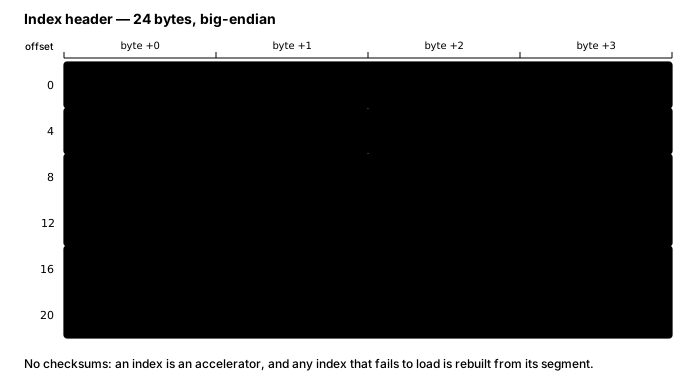
| Offset | Size | Field | Value |
|---|---|---|---|
| 0 | 4 | magic |
0x464C5349 ("FLSI") |
| 4 | 2 | version |
3 when written; 2 and 4 are still read, the layout is the same |
| 6 | 2 | flags |
0 |
| 8 | 8 | base_offset |
must equal the segment’s base_offset |
| 16 | 8 | reserved |
0 |
Index entry (16 bytes)
Section titled “Index entry (16 bytes)”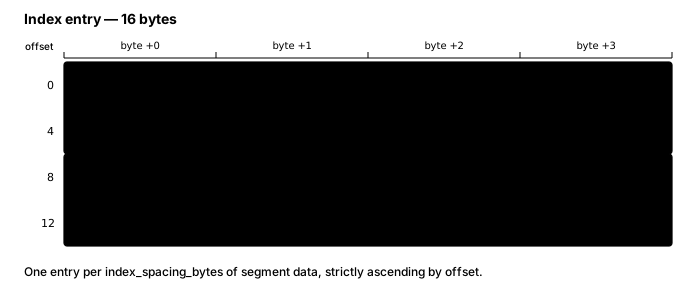
| Offset | Size | Field |
|---|---|---|
| 0 | 8 | offset |
| 8 | 8 | position: byte position of that record in the segment |
Entries are emitted for the segment’s first record and thereafter every
index_spacing_bytes of segment data. They are strictly ascending by offset,
which is what seek_position’s binary search relies on.
A torn final entry, which is what a crash mid-append leaves, is tolerated on load: the file is read up to the last whole entry.
Compatibility and corruption behaviour
Section titled “Compatibility and corruption behaviour”| Condition | Behaviour |
|---|---|
Unknown magic |
Reject: CorruptionKind::SegmentMagic / IndexMagic |
Unknown version |
Reject: SegmentVersion / IndexVersion. Never “best effort” |
Non-zero flags |
Reject: SegmentFlags. Unknown bits may change the layout behind them, so they are not masked off |
| Bad header CRC | Reject: SegmentHeaderChecksum |
| Short read | Truncated { needed, available }, the one shape recovery may repair |
| Bad record header CRC | RecordHeaderChecksum; the length cannot be trusted |
| Bad record CRC | RecordChecksum |
| More than one of the three kind bits set | RecordFlags |
payload_len over the limit |
RecordTooLarge, raised before any allocation |
| Offset gap within a segment | OffsetOutOfOrder |
Every error carries a CorruptionSite naming the shard, segment id and byte
position, because “corruption detected” alone is not enough to act on.
What recovery may repair
Section titled “What recovery may repair”Recovery truncates only damage confined to the end of the newest segment, because only there can a record have been mid-write when the process died:
- A
Truncatedfailure is always repairable. The header verified, sopayload_lenis the length the writer intended, and a file ending short of it is provably an unfinished write. Nothing can have acknowledged a record that was never finished. This is the ordinary crash case and needs no operator involvement. - A
RecordHeaderChecksumfailure is not repairable by default. The header cannot be trusted, so this may equally be an unfinished write or a complete, acknowledged record whose header rotted.repair_checksum_tailopts in. - A
RecordChecksumorOffsetOutOfOrderfailure is likewise opt-in: the header verified, so the record is complete on disk and the damage is rot rather than a torn write. - A
RecordTooLargefailure is opt-in for the same reason: the writer rejects oversized records, so a verified header carrying an impossible length is damage the checksums did not catch. - Segment-header damage is never repairable, with one exception below: a blank first segment.
- A blank first segment. When segment 0 is the log’s only segment, it is no longer than a header, its header is missing or all zeros, and the durable mark vouches for nothing past the header, its creation failed (on a full disk, say) before it could hold a record. Recovery deletes it and the log starts again empty, or at its placed base. Creation syncs the header before anything can append, and preallocation does not change the file size, so a first segment longer than a header had a durable header. A zeroed header there is damage to acknowledged records and stays fatal, even when every byte after it is zero too.
The dividing line is whether the length is trustworthy. When it is, recovery can prove the write was unfinished; when it is not, recovery refuses to choose between “unfinished” and “rotted” and fails loudly instead.
The full rules live in is_repairable_tail in
segment/scan.rs.
Golden vectors
Section titled “Golden vectors”format.rs pins exact bytes for a segment header and a record. Changing either
is a format change: bump FORMAT_VERSION, update this document, and state the
migration path.
SegmentHeader::new(base_offset = 1, created_at_micros = 2):  46 4C 53 47  00 03  00 00  00 00 00 00 00 00 00 01  00 00 00 00 00 00 00 02  AD EB 65 E9  00 00 00 00
SegmentHeader::at_version(1, 2, version = 4), for a segment holding ageneration-start record, differs only in the version and the CRC:  version 00 04, header crc E7 D5 EE A2
encode_record(offset = 7, timestamp = 9, payload = "hi"):  00 00 00 02  00 00 00 00 00 00 00 07  00 00 00 00 00 00 00 09  C6 54 DE 27  24 02 15 2C  68 69
Version history
Section titled “Version history”| Version | Change |
|---|---|
| 1 | Initial format. Unreleased. |
| 2 | Added header_crc to the record header (24 → 28 bytes), making a corrupted length field detectable without reading the payload. |
| 3 | Producer marks: two flag bits in payload_len and an optional 20-byte tag. A v2 segment is read unchanged; an unmarked record is byte for byte a v2 record. |
| 4 | Generation-start records: a third flag bit in payload_len. Written only to hold that record, once generation_start is finalized; v2 and v3 segments are read unchanged. |
A v1 segment is rejected on open with CorruptionKind::SegmentVersion, naming
the version found. v1 was only ever written by unreleased builds, so the
migration path is to discard the data directory rather than carry a second
decoder. Rejecting is the safe failure, because a v1 record read as v2
would misparse every field after the length.
Versioning policy
Section titled “Versioning policy”FORMAT_VERSION is a single number covering both the segment and index layouts.
- Additive changes that keep existing readers correct (new
flagsbits with strictly appended data) still require a version bump, because current readers reject unknown flags rather than skipping them. That is deliberate. Silently ignoring a bit that changes the meaning of the bytes after it is how formats become unreadable. - Any change to a field’s position, width, or meaning requires a bump and an explicit migration path. Segments already on disk are not rewritable in place.
Limits
Section titled “Limits”| Limit | Value | Why |
|---|---|---|
MAX_PAYLOAD_BYTES |
64 MiB | Bounds the allocation a corrupt length field can request |
| Max records per segment | u64 offsets, so effectively unbounded |
Rollover is driven by size, not count |
| Oversized records | A record larger than segment_size_bytes is written to an otherwise-empty segment of its own |
Splitting a record across segments would break the “offsets are contiguous within a segment” invariant that recovery depends on |
epochs: the generation history
Section titled “epochs: the generation history”A shard directory may hold an epochs file beside its segments. It records
where each leadership generation began, as (generation, start offset) pairs,
with one entry per leadership change rather than per record. An entry names the generation
that wrote the records from its offset on, on a follower too: a follower copies
the entries from the leader’s batches rather than labelling what it is sent
with the generation of the leader that sent it.
0 4 magic u32 "FLEP" 4 2 version u16 6 2 count u16 entries following 8 4 body_crc u32 crc32 over the entries12 … entries count × { generation u64, start_offset u64 }Written through a temporary and a rename, so a crash leaves either the old file or the new one. A half-written history is worse than none, because it would be read back as a confident answer about where a generation began, and that answer becomes a truncation point.
Unlike the segments, this file is not authoritative and its loss is not fatal. Absent, short, or failing its checksum, it reads as empty: every shard written before the file existed has none, and refusing to open those would trade an outage for a convenience. What is lost is the ability to repair a divergence automatically, never a record.
The entries are bounded, because every open reads the whole file and a generation older than the oldest retained record cannot be one two brokers diverge within.
See docs/replication-design.md, “Divergence and truncation”, for what it is
for.
replica: the accepted generation and the commit offset
Section titled “replica: the accepted generation and the commit offset”A shard directory that has been replicated to, or led, holds a replica file:
the highest leadership generation this broker accepted a leader of the shard
at, and the commit offset it knows, one past the last record a majority
acknowledged.
0 4 magic u32 "FLRS" 4 2 version u16 6 2 reserved u16 8 8 generation u64 highest generation accepted16 8 commit u64 one past the last record known committed24 4 crc u32 crc32 over bytes 0..24Written through a temporary, an fsync, a rename and a directory sync. A raised
generation is on disk before the batch that raised it is stored or
acknowledged, so a leader this broker has seen replaced is refused after a
restart too, whatever the routing view says by then. The commit offset is
written behind the advance that raised it, so no acknowledgement waits on this
file. Under FsyncMode::OnCommit the write starts at once and one write in
flight carries every advance made while it runs; under Periodic and None it
is written at most once a second. In every mode it is written at shutdown, and
a failed write is retried once a second until it lands. Read back behind after
a crash, it permits more truncation than it should: records committed since
are unguarded until the leader’s next batch carries the offset again.
Unlike epochs, this file is authoritative. Nothing in the log can rebuild
it, and reading a damaged one as zero would accept any leader, so a file that
is present and does not decode fails the open. Absent reads as zero: nothing
accepted, nothing known committed. Cache and counter compaction leave it
alone: they trim segments in place and never replace the directory.
A truncation or rebuild that would discard a record held below the commit
offset is refused with StorageError::BelowCommit; see
docs/replication-design.md, “Divergence and truncation”.
ballot: whom the generation was accepted from
Section titled “ballot: whom the generation was accepted from”Beside replica, once a broker that keeps ballots has accepted a generation
from a named leader: that generation and the leader’s node id.
0 4 magic u32 "FLBL" 4 2 version u16 6 2 leader_len u16 at most 1024 8 8 generation u64 the generation the leader was accepted at16 n leader utf-8 node id, leader_len bytes16+n 4 crc u32 crc32 over bytes 0..16+nWritten the same way as replica, and before it when a generation is raised,
so the ballot is on disk before anything from that leader is stored or
acknowledged. At the accepted generation only that leader is answered; see
docs/replication-design.md, “Ballots”. On open, a ballot at the generation
in replica names its leader, one ahead of it is a raise that crashed between
the two writes and its generation is taken, and one behind it, or none, names
no leader. A file that is present and does not decode fails the open, as
replica does. A separate file so that a build that predates ballots ignores
it and still opens the shard.
An empty leader (leader_len 0) is a generation given up: a broker back from
a crash that may have cost it records it acknowledged writes it over its own
ballot, so no leader is accepted at that generation, this broker included,
and only a newer one replaces it (DiskLog::give_up_generation; see
docs/replication-design.md, “A leader’s own crash”).
offload.manifest: segments with a copy in the object store
Section titled “offload.manifest: segments with a copy in the object store”A stream shard whose broker runs with offload on (see docs/durable-storage.md,
“Tiered storage: offload”) holds an offload.manifest: one entry per sealed
segment with a verified copy in the object store, ordered by base offset.
0 4 magic u32 "FLOF" 4 2 version u16 6 2 reserved u16 8 4 count u32 entries that follow12 entries, each: 0 8 segment id u64 8 8 base offset u64 16 8 last offset u64 inclusive 24 8 size u64 bytes in the object, the segment's valid bytes 32 8 oldest u64 timestamp_micros of the first record 40 8 newest u64 timestamp_micros of the last record 48 4 checksum u32 crc32 over the object's bytes 52 2 key length u16 54 n key UTF-8 object key end-4 4 crc u32 crc32 over every byte before itA key is <node id>/<shard directory name>/<base offset>-<segment id>.segment,
with both numbers zero-padded to 20 digits. The node id keeps replicas of one
shard apart when brokers share an offload directory. Entries written by
0.6.0-preview.3 have keys without it and are read as they are: an entry names
its object by the full key, never by recomputing it.
Entries never overlap. Gaps between them are allowed: a segment retention deleted while offload was off was never copied. Written through a temporary, an fsync, a rename and a directory sync, and always before the local segment it records is unlinked.
This file is authoritative. Once a segment’s local file is gone, the entry is the only record that its records still exist, so a manifest that is present and does not decode fails the open. Absent reads as empty. A truncation drops the entries holding offsets at or after the cut, and a reset drops them all, both before any segment is touched.
producers: the producer snapshot
Section titled “producers: the producer snapshot”Each idempotent producer’s place in the log is derived from the marks: for every producer, the newest sequence held and where its recent batches landed, plus a batch still waiting for records. Replaying the whole log on every open would make opening a large shard slow, so the state is saved at each rollover, as of the new segment’s base offset, once the retired segment is sealed.
0 4 magic u32 "FLPS" 4 2 version u16 6 2 reserved u16 8 8 as_of u64 the state covers every record below this offset16 4 producers u3220 4 body_crc u32 crc32 over what follows24 1 open 1 when a batch is waiting for records, then: producer_id u64, sequence u64, len u32, first u64, held u32 … producers × { id u64, last_sequence u64, batches u16, batches × { first u64, len u32 } }An open reads it and replays only the marks after as_of. Those are normally
all in the active segment, which recovery scans in full anyway, so a current
snapshot costs no read at all. A snapshot that is missing, damaged, below the
oldest retained record or past the tail is ignored and the state is rebuilt from
the oldest record. A truncation removes it, durably, before anything is written
past the cut, since it would describe records that were replaced.
It is derived, like the index, so it is written through a temporary and a rename but not flushed: one lost to a crash costs a longer open.
What is remembered is a function of the log. A producer is known while one of its batches is in the log; retention that removes the last of them forgets it, on every replica alike. Each producer keeps its last 64 batches, and past 4096 producers the one whose newest batch is oldest is forgotten.
keys.idx: a cache’s key index
Section titled “keys.idx: a cache’s key index”A cache shard maps each key to the record that currently defines it. That index lives in memory and is otherwise rebuilt by replaying the whole log when the shard opens. At the end of each compaction pass, after the trim, it is written here, and an open loads it and replays only the records past it. Only cache shards have one.
0 4 magic u32 "FXIX" 4 2 format u16 1 6 1 store u8 0 for a cache (1 is reserved for collections) 7 8 covered_through u64 every record below this offset is reflected, none at or past it15 8 entry_count u6423 8 log_bytes u64 payload bytes of every record below covered_through, live or not31 4 last_checksum u32 checksum of the record at covered_through - 1; 0 when nothing is covered35 … entry_count × { key_len u32, key, offset u64, version u64, expires_at_millis u64, bytes u32 } 4 crc u32 CRC-32C over everything before itEach key is a composite key, and entries are sorted by it, compared as bytes:
kind u8 | key_len u32 | key | slot u8 | fieldKind 0 is a cache value, which has no slot or field. Kinds 1, 2 and 3 are
reserved for hashes, sets and lists, where slot 0 is the key’s metadata and
slot 1 a field. The 28 bytes after the key are the in-memory entry: where the
record is, the version a conditional write compares against, the absolute
expiry (0 for none), and the record’s payload length. log_bytes carries
compaction’s garbage ratio across the restart.
It is derived, so an open checks it against the log before using it, and a snapshot that fails any check is logged and ignored, and the whole log is replayed:
- the length and the checksum match, and every key is a cache key;
covered_throughlies between the log’s oldest offset and its tail. Below the oldest offset, a later pass trimmed records the snapshot never saw; past the tail, records it did see are gone;- every entry points at an offset from the log’s oldest up to
covered_through; - the record at
covered_through - 1haslast_checksum. Offsets alone cannot tell this log from one replication cut back and refilled to the same length.
A truncation removes it, durably, with the producer snapshot, and so does
dropping the cache’s index after replication cut its log. It is written to
keys.idx.tmp, flushed, renamed over keys.idx, and the directory flushed;
the log is flushed first, so the records it covers are on the device before it
is. A temporary left by a crash is never read and is overwritten by the next
pass. Unlike the producer snapshot it is flushed: losing it costs a replay of
the whole log, which is what it exists to avoid.
It shortens an open, not memory: the index is still held whole in memory.
storage-id and run-state: the data directory’s identity
Section titled “storage-id and run-state: the data directory’s identity”storage-id holds 16 random bytes the broker generates the first time it
opens the directory ("FLID", a version, the id, a CRC). run-state says
whether the last run stopped cleanly:
0 4 magic u32 "FLRN" 4 2 version u16 6 1 state u8 1 = running, 2 = stopped cleanly 7 1 flags u8 bit 0: the run acknowledges before syncing (periodic or none) 8 16 id the storage id the run started under24 4 crc u32 crc32 over bytes 0..24Both are written to a .tmp file, flushed, renamed and the directory flushed.
A start that finds running with bit 0 set writes a new storage-id before
anything else, because the crash may have lost records the broker had already
acknowledged. See docs/storage-format.md
for the rest of the rules.
registration holds the node incarnation the control plane gave at the last
registration ("FLRG", a version, the incarnation as a u64, a CRC). A cluster
member asks the control plane for its current incarnation before any store
opens, and writes a new storage-id when the control plane is ahead: the
directory is older than the node’s last registration, as a restored volume
snapshot is.