
Overview
Felix is a distributed data backend that serves three things most systems run three products for: event streams, work queues, and a key-value cache. All three are readings of the same replicated, append-only log, reached over one QUIC connection.
This page is the short version of how it fits together. The status table is the page to trust for what is and is not built.
The core idea
Section titled “The core idea”Internally there is one primitive, an append-only log per shard, and streams, queues and the cache are three ways of reading it. Why Felix? explains the idea in plain terms; this page covers the parts.
What Felix optimizes for
Section titled “What Felix optimizes for”Felix puts predictable latency under load ahead of peak batch throughput. Several choices follow from that.
Felix clients use QUIC, so streams multiplex over one connection without
head-of-line blocking, and every connection is TLS 1.3. Queues are bounded and
their overflow policy is explicit, so one slow path degrades locally instead of
cascading. A stalled subscriber loses its own events (under the default
drop_new policy) rather than stalling the publisher or other subscribers; the
slow-consumer demo runs both policies
side by side. Batching bounds, flow-control windows, pool sizes and fsync policy
are all ordinary configuration.
Measured numbers are kept on the Benchmarks page so they only need updating in one place.
The pieces
Section titled “The pieces”These are the main pieces. Everything below the dotted line is transport-independent: the broker core has no idea QUIC exists, which is what makes it testable in-process.
flowchart TB
    subgraph app["Your application"]
        direction LR
        A1(["publisher"])
        A2(["subscriber"])
        A3(["cache client"])
    end

    SDK["felix-client<br/><small>publisher / subscription / cache APIs,<br/>connection + stream pools</small>"]
    WIRE["felix-wire<br/><small>frame header, JSON control messages,<br/>binary data-plane frames</small>"]
    TRANS["felix-transport<br/><small>QUIC endpoints, streams, flow control,<br/>dedicated I/O runtimes</small>"]
    BRK["felix-broker<br/><small>stream registry, log, subscriber<br/>registry, fanout</small>"]
    SVC["services/felix-broker-service<br/><small>network service: handlers, auth,<br/>metrics, control-plane sync</small>"]
    CP["services/felix-controlplane-service<br/><small>tenants, namespaces, streams,<br/>tokens, RBAC</small>"]

    A1 e1@--> SDK
    A2 e2@--> SDK
    A3 e3@--> SDK
    SDK e4@--> WIRE
    WIRE e5@--> TRANS
    TRANS e6@-->|"QUIC + TLS 1.3"| SVC
    SVC e7@--> BRK
    SVC e8@-.->|"seeds metadata at startup"| CP

    e1@{ animate: true }
    e2@{ animate: true }
    e3@{ animate: true }
    e4@{ animate: true }
    e5@{ animate: true }
    e6@{ animate: true }
    e7@{ animate: true }

    classDef step fill:#e8f0fe,stroke:#4a6fa5,color:#1a2b40
    classDef core fill:#fdf0e3,stroke:#b07d3a,color:#3d2a12
    classDef endpoint fill:#e9f5ec,stroke:#4a8a5e,color:#16301f
    class SDK,WIRE,TRANS,SVC step
    class BRK,CP core
    class A1,A2,A3 endpoint
felix-wireis the protocol: a fixed frame header, JSON control messages, binary frames on the data plane, and capability negotiation so old and new peers interoperate. Full details in Wire Protocol.felix-transportwraps QUIC: endpoints, streams, flow-control windows, and dedicated I/O runtimes so the transport driver is never starved by application tasks.felix-brokeris the data plane with no networking in it: the log, subscriber registry, fanout, cache index, consumer groups.felix-storagewrites the durable log to disk as append-only segments. See Durable Storage.felix-replicationships each shard’s log from its leader to its followers and counts the majority aQuorumwrite waits for.felix-clientis the Rust SDK: publisher, subscription, and cache APIs over pooled connections, with reconnection and redirect-following in the cluster client. Python (crates/sdk/felix-python) and TypeScript (crates/sdk/felix-typescript) ship too, both as bindings over this client rather than reimplementations. A C# SDK (sdks/dotnet,Felix.Clienton NuGet) binds the C ABI over the same client; Go is not started.- The control plane (
services/felix-controlplane-service) holds metadata (tenants, namespaces, streams, caches, nodes) behind a REST API, and assigns every shard to a broker. Brokers watch its assignment feed. It is not on the data path: a publish never waits on it.
Delivery guarantees, plainly
Section titled “Delivery guarantees, plainly”Configured per stream:
- Ephemeral streams are at-most-once. The broker acknowledges receipt, fans out from memory, and a subscriber that falls behind misses records. This is the low-latency mode, and the right one when stale data is worthless anyway.
- Durable streams persist every record and replay from any retained
offset. By default a publish is acknowledged after the write, under the
fsync policy.
FELIX_ACK_ON_COMMIT=0acknowledges when it is queued instead, which is faster but can lose an acknowledged record in a crash. Withconsistency: quorum, the acknowledgement additionally waits until a majority of the replica set holds the record, so a failover cannot lose an acknowledged write. - Consumer groups redeliver anything unacknowledged, count attempts, and park repeat failures as dead letters you can list, discard, or redrive.
- Idempotent producers make a re-sent publish land once, but delivery is not exactly-once: a consumer can still see a record twice on redelivery, so deduplicate there if duplicates matter.
A lost leader is replaced by a replica that provably holds the log. That takes about a second on a local three-node cluster. This is tested against process kill, graceful stop, a leader frozen past its lease, and a partitioned broker that keeps heartbeating.
Security
Section titled “Security”Today: TLS 1.3 on every connection, OIDC token exchange at the control plane,
tenant-scoped tokens, RBAC enforced at the broker, and mutually authenticated
broker-to-broker QUIC once FELIX_INTERNAL_TLS_CERT, _KEY and _CA are set.
Not yet: end-to-end payload encryption, encryption at rest, audit logging.
Details in Security.
Running it
Section titled “Running it”A single broker is fine for development and for workloads that fit on one machine. Durable storage and the cache both work on one broker; replication needs a second one to replicate to.
A cluster is brokers plus a control plane:
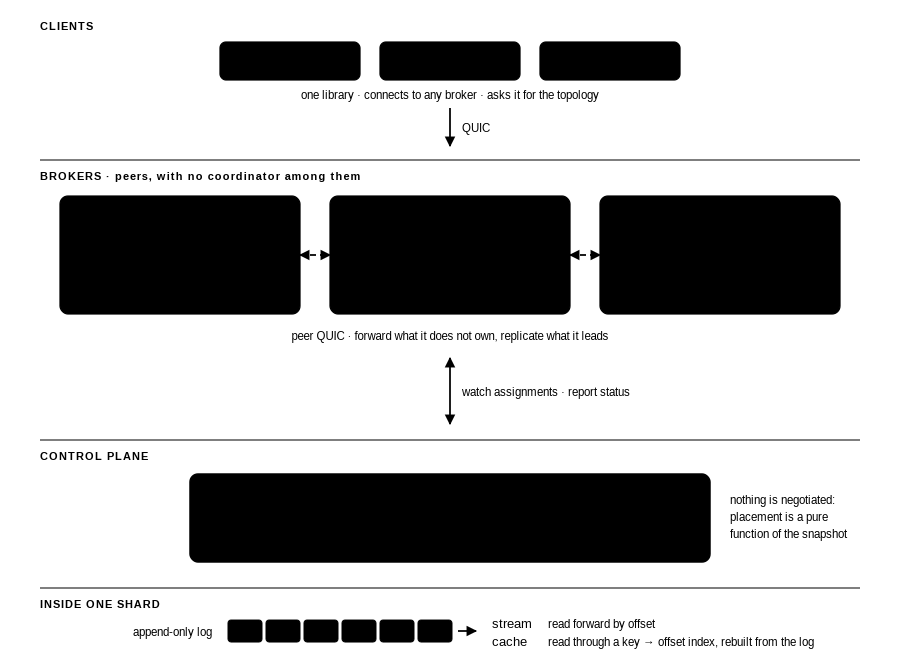
The control plane keeps its metadata in one of two backends:
| Backend | What holds the metadata | When to pick it |
|---|---|---|
memory |
This process, nothing else. The default when no Raft variables are set. | Development, and the harness |
raft |
The control-plane instances themselves, replicated between them | Everything that must survive a restart: there is no external database to run |
Raft is the production backend: the instances form a quorum and survive losing one without losing an acknowledged write. See Metadata Raft and Control-plane HA.
Felix runs anywhere a process runs. For orchestrators it ships the pieces they expect: readiness and liveness endpoints that answer different questions, and a bounded graceful drain on SIGTERM. See Graceful shutdown.
Is Felix right for your workload?
Section titled “Is Felix right for your workload?”Why Felix? says when not to use it, and What Felix Is For is the status table, kept current per capability.
Where next
Section titled “Where next”- Quickstart: run a broker and the demos
- Tutorials: build a small app step by step
- Installation: build from source
- Pub/Sub Streaming: the feature most readers want first
- System design: the architecture in depth