
felix-metro
felix-metro is a city simulator that runs in the browser in 3D. Residents commute, shop and go home over a day that takes 24 minutes. Everything that happens is written to Felix, so you can drag the timeline back to any moment the log still holds, see the city exactly as it was, and let it play forward until it catches up with live.
It is playable. A simulator steps the city and the browser draws it live.
What works:
- Dragging the timeline back through the hours the log still holds, playing the past forward and rejoining live with no gap.
- Following one resident through their day.
- Signing in as a builder to put up buildings and lay roads.
Not built yet:
- Zones.
- Forking a city from the page (the simulator can already fork).
The README has the controls and a quick start. The sections below describe how it works.
| Day | Night |
|---|---|
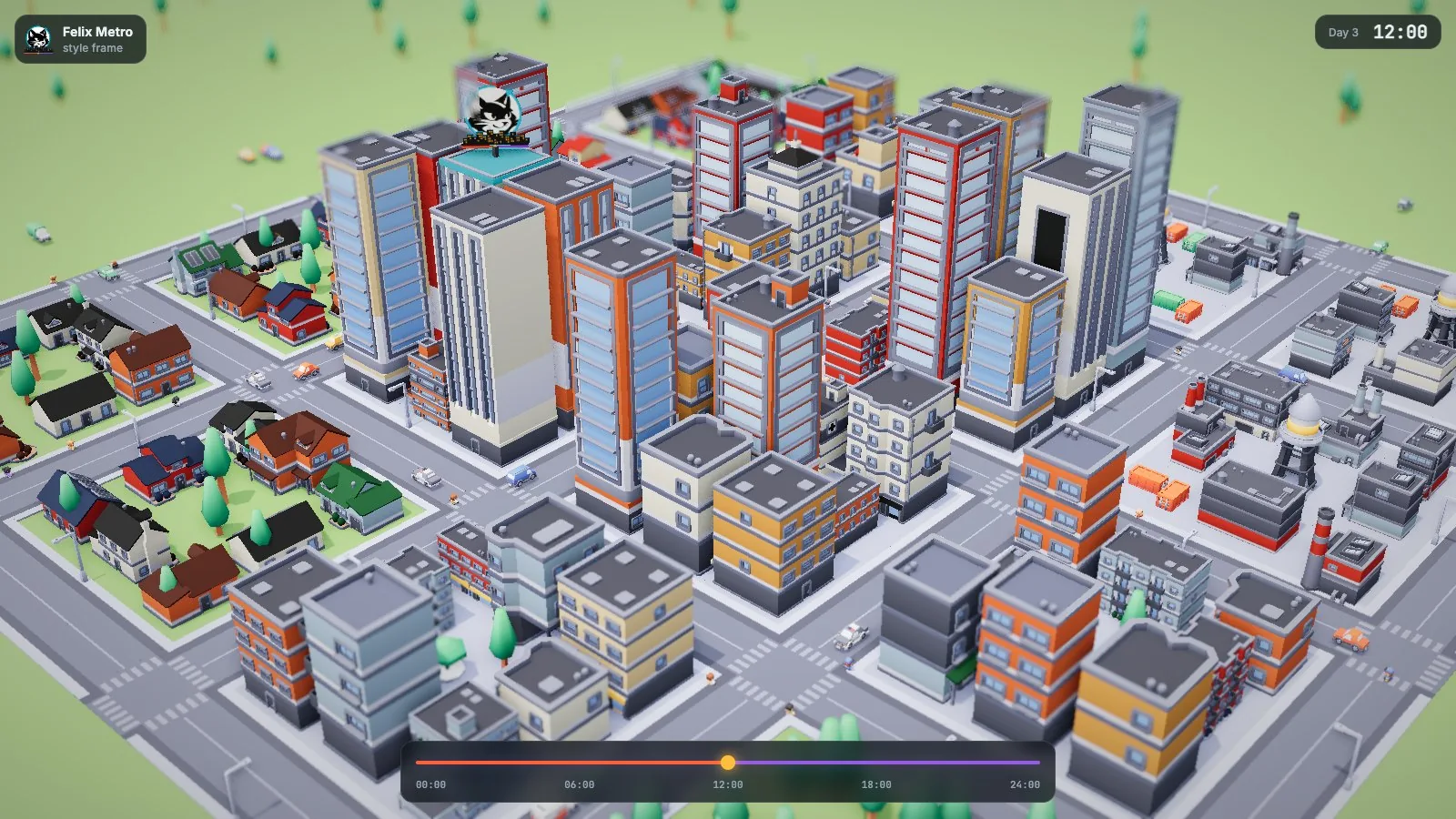 |
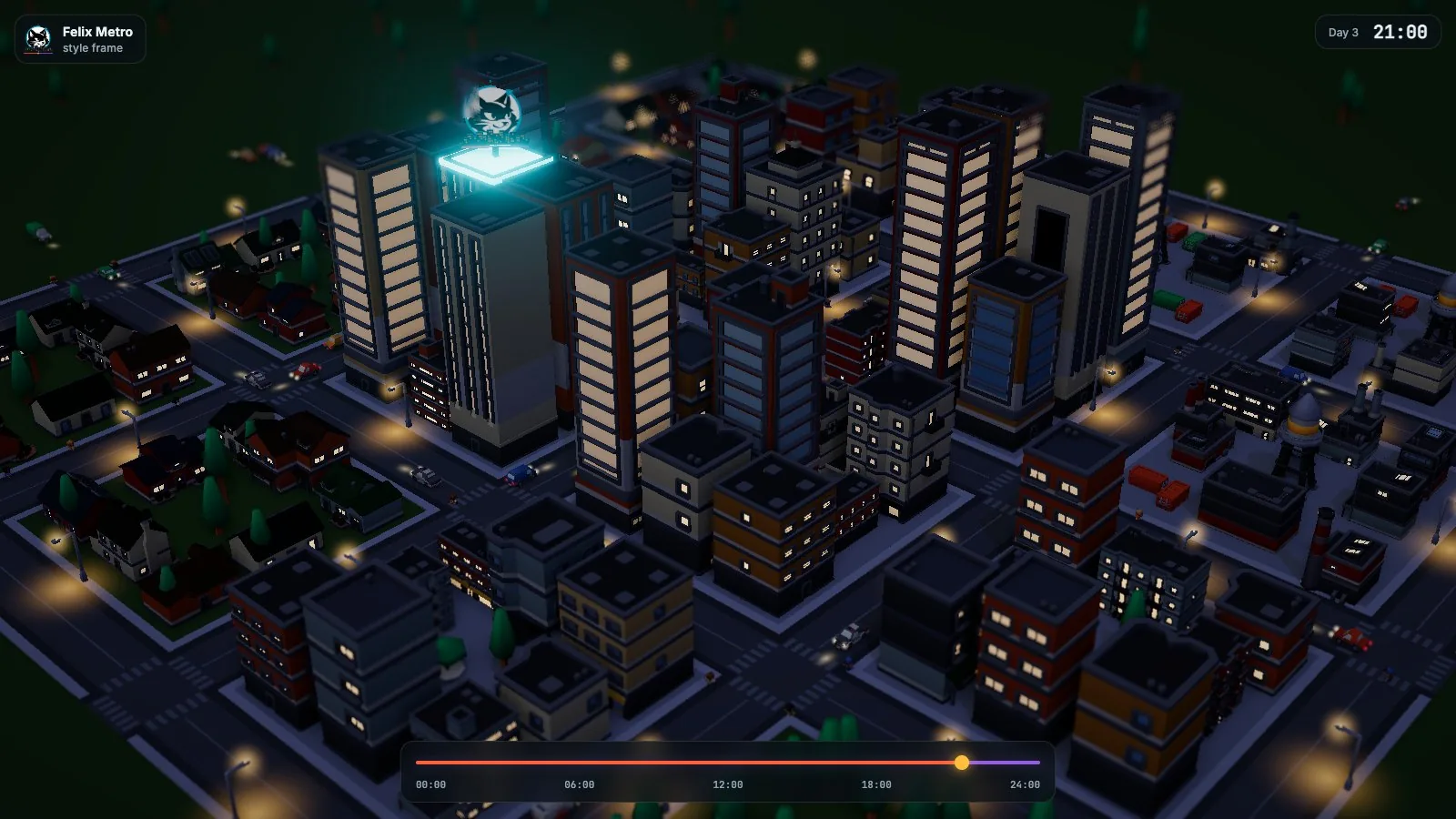 |
How it uses Felix
Section titled “How it uses Felix”A city is a grid of districts. Its resources are created once, when the city is:
| Resource | Kind | What it holds |
|---|---|---|
metro.events.<city> |
Durable stream, one shard per district | One record per district per simulation tick, with that tick’s events |
keyframe |
Stream state key on each district’s shard | The offset of the district’s latest keyframe |
metro.commands.<city> |
Durable stream with the gateway’s sender stamp | Builders’ commands: place a road, zone a lot, demolish |
One simulator per city is the authority. It steps every district together, four ticks a second at normal speed, each tick 15 seconds of city time. Each tick it writes one record per district as an atomic commit, routed by the district so each district’s history stays in order on its own shard. It waits for every answer before the next tick, and it commits at an expected offset, so a stale simulator that comes back after a replacement is refused by the broker instead of writing a second history.
The log holds decisions, not positions. A tick record says that a resident left home on a route at some speed, arrived somewhere, or that a building went up. The browser moves each car along its route itself. That keeps a city of 20,000 residents at about 10 KB/s of log, so a week of history fits on one broker.
Every city hour each district also commits a keyframe, its whole state, and the
same commit writes the keyframe state key, so the pointer and the keyframe can
never disagree. Every tick record carries the offset of its district’s latest
keyframe.
Going back to a moment is, for each district:
- Find the tick record for that moment. There is one record per tick, so the client estimates the offset and corrects it with one read.
- Read the keyframe that record points to.
- Read the range from the keyframe to the moment and apply the events.
Playing forward is a subscription from the next offset. Felix joins stored history to live delivery with no gap, so the city catches up with live without the client doing anything special.
flowchart LR
  B["Browser"] -- "WebSocket" --> G["felix-gateway"]
  G -- "commands" --> CMD[("metro.commands<br/>durable")]
  CMD --> SIM["Simulator, 4 Hz"]
  SIM -- "atomic commit per district per tick" --> EV[("metro.events<br/>one shard per district")]
  EV -- "range reads to go back, subscribe to play forward" --> G
Browsers reach Felix through felix-gateway, which offers
read, state_get and offset_for_time, so seeking by time is one lookup per
district.
What it demonstrates
Section titled “What it demonstrates”- History as the product. The timeline is a range read and a subscription, not a second datastore of snapshots.
- Seeking that stays fast. A keyframe every city hour bounds a seek to one keyframe and an hour of events per district.
- Rewind, then follow live with no gap, across many shards at once.
- One writer per city, fenced at the broker by expected-offset commits.
- Forks from the past. A branch timeline starts from a keyframe of the parent and owes it nothing after that. The simulator forks a city this way; the page does not offer it yet.
- README
- Design: the data model, seeking, branching and what is still to build
- Art direction: the asset packs and the style frame